Test your knowledge on the fundamental concepts of history as a discipline. This quiz covers its origins, methods, and the types of sources historians use.
Pages: 3Questions per page: 10
Rate this quiz
☆☆☆☆☆
Avg: 0.00 ( 0 )
Score: 0Page 1 / 3
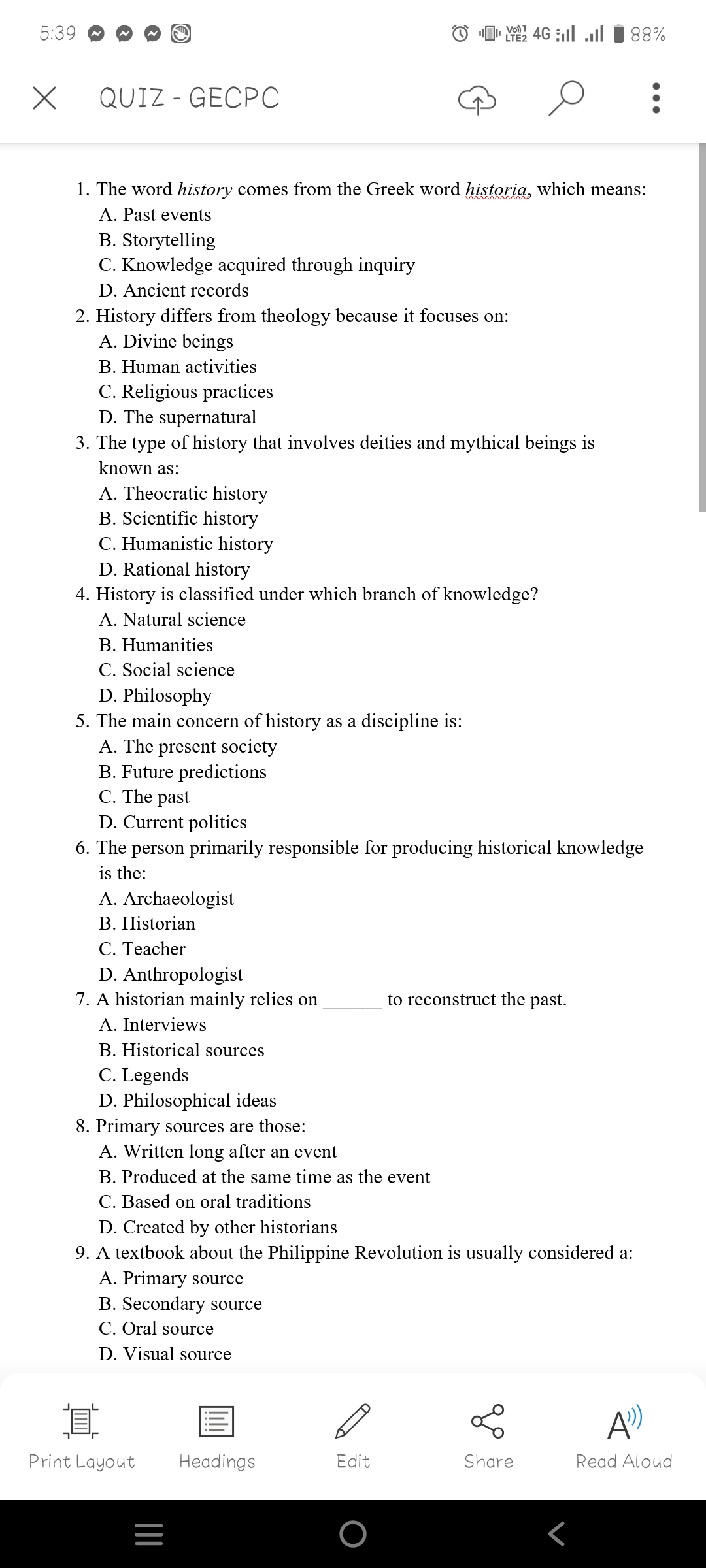
1. According to the quiz, the word 'history' comes from the Greek word 'historia'. What does 'historia' mean?
Explanation: Question 1 states that the Greek word 'historia' means 'Knowledge acquired through inquiry', highlighting history's roots in investigation rather than just storytelling.
2. How does history differ from theology, based on the information in question 2?
Explanation: Question 2 differentiates history from theology by stating that history focuses on human activities, whereas theology typically deals with the divine and supernatural.
3. What is the term for a type of history that involves deities and mythical beings?
Explanation: As per question 3, 'Theocratic history' is the specific type of history that incorporates deities and mythical beings into its narrative and explanation of events.
4. Under which branch of knowledge is history classified in this quiz?
Explanation: Question 4 presents options for classifying history, with 'Humanities' and 'Social science' being the most common classifications. In many academic contexts, it is a core discipline of the Humanities.
5. What is the main concern of history as a discipline, according to question 5?
Explanation: Question 5 identifies 'The past' as the primary focus and main concern of history as an academic discipline.
6. Who is the person primarily responsible for producing historical knowledge?
Explanation: Question 6 points out that while other professions work with the past, the 'Historian' is the one primarily responsible for researching, interpreting, and producing historical knowledge.
7. What does a historian mainly rely on to reconstruct the past?
Explanation: Question 7 indicates that 'Historical sources' (both primary and secondary) are the foundational evidence that historians use to build their understanding of the past.
8. Based on question 8, what is the definition of a primary source?
Explanation: Question 8 defines primary sources as those 'Produced at the same time as the event', meaning they are first-hand accounts or artifacts from the period being studied.
9. How would a textbook about the Philippine Revolution typically be classified as a source?
Explanation: Question 9 uses a textbook as an example of a 'Secondary source' because it is an analysis and interpretation of events written after they occurred, based on primary sources.
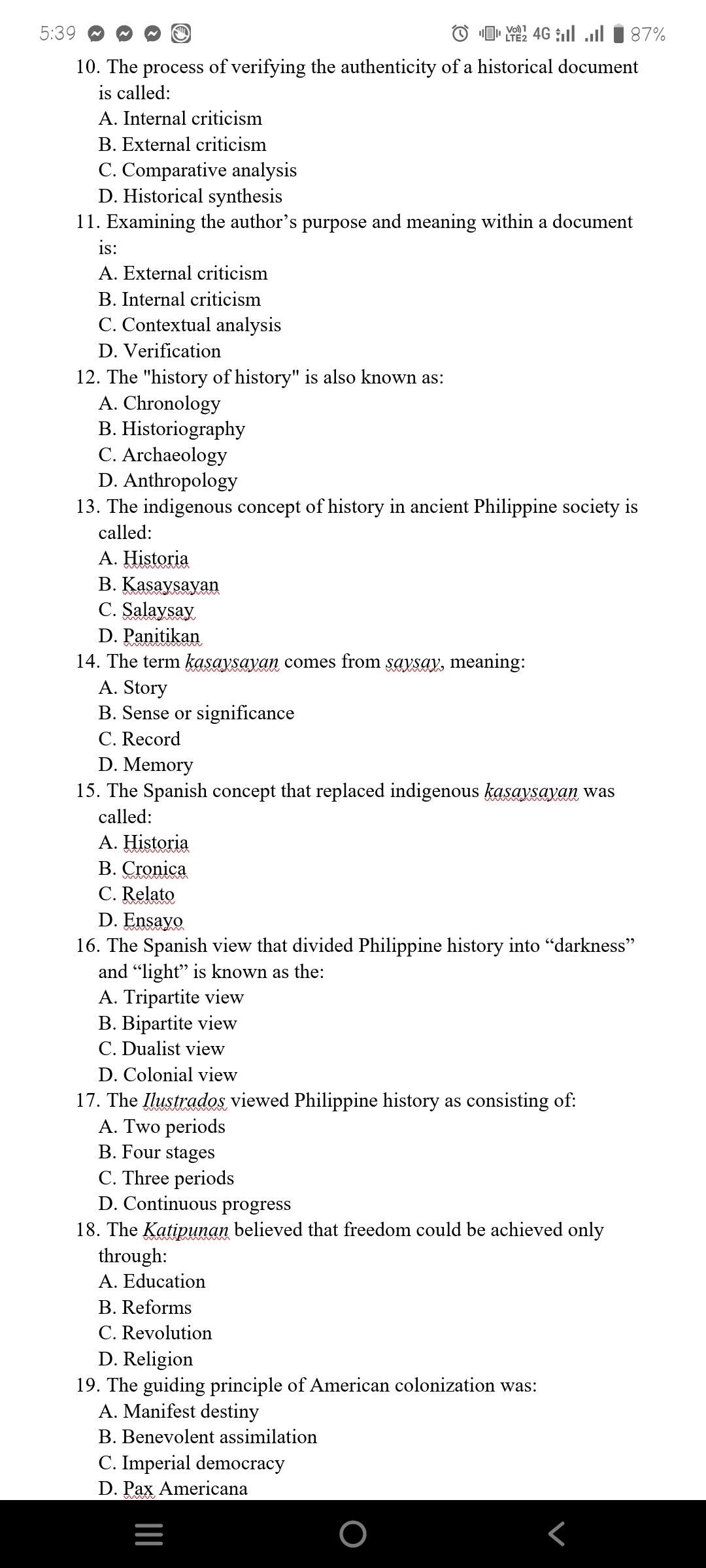
10. The process of verifying the authenticity of a historical document is called:
Explanation: External criticism is the process of checking the authenticity of a source by examining its physical characteristics, consistency with the historical period, and the materials used for it. It seeks to determine if the document is a forgery or what it claims to be.
11. Examining the author's purpose and meaning within a document is:
Explanation: Internal criticism evaluates the credibility and trustworthiness of the content of a historical source. It involves assessing the author's purpose, bias, and the meaning of the statements within the document.
12. The 'history of history' is also known as:
Explanation: Historiography is the study of the methods of historians in developing history as an academic discipline, and by extension, is any body of historical work on a particular subject. It is literally the 'history of history'.
13. The indigenous concept of history in ancient Philippine society is called:
Explanation: Kasaysayan is the Tagalog term for history, derived from 'saysay' (meaning) and 'salaysay' (narrative). It emphasizes history as a meaningful story of the people, distinct from the Western, often event-based 'Historia'.
14. The term kasaysayan comes from saysay, meaning:
Explanation: The Filipino concept of 'kasaysayan' is rooted in the word 'saysay', which means sense, meaning, or significance. This implies that for a narrative to be considered history, it must have relevance and meaning to the people.
15. The Spanish concept that replaced indigenous kasaysayan was called:
Explanation: The Spanish colonizers introduced their own concept of 'Historia', which was a chronological record of events, often focusing on the actions of the colonizers and their institutions, replacing the indigenous people-centric 'Kasaysayan'.
16. The Spanish view that divided Philippine history into 'darkness' and 'light' is known as the:
Explanation: The Spanish colonial historiography promoted a bipartite view, framing the pre-colonial era as a period of 'darkness' and the colonial period as an era of 'light' brought by Christianity and Spanish civilization.
17. The Ilustrados viewed Philippine history as consisting of:
Explanation: Filipino reformists, or 'Ilustrados' like Jose Rizal, promoted a tripartite view of history: a prosperous pre-colonial past, a period of decline and 'darkness' under Spanish rule, and a future of awakening and progress.
18. The Katipunan believed that freedom could be achieved only through:
Explanation: Unlike the reformist Ilustrados who initially sought reforms within the Spanish system, the Katipunan, led by Andres Bonifacio, believed that the only way to achieve independence and freedom from Spain was through armed revolution.
19. The guiding principle of American colonization was:
Explanation: 'Benevolent assimilation' was the policy and term used by U.S. President William McKinley to describe the American colonization of the Philippines, framing the occupation as a mission to develop, civilize, and educate the Filipinos.
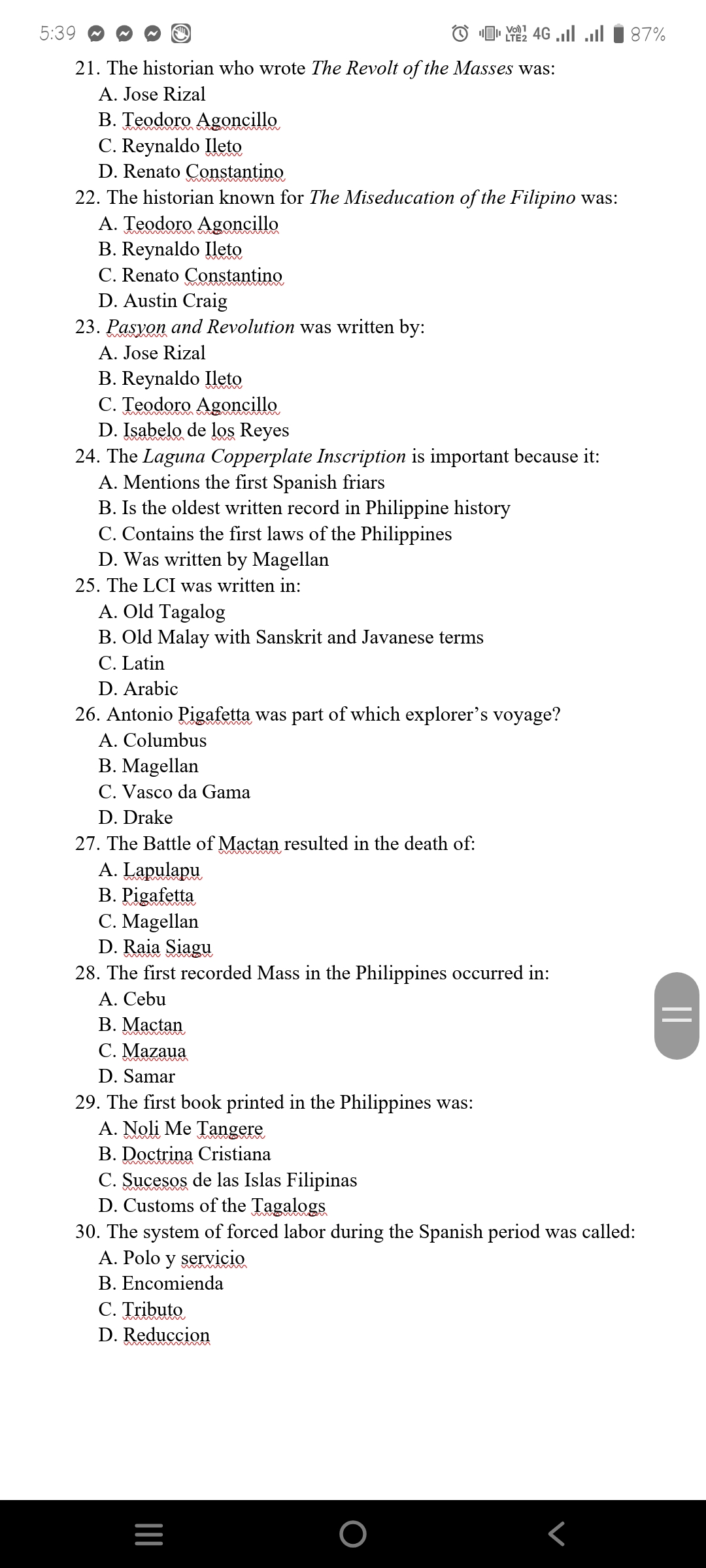
20. Who is the author of the historical work 'The Revolt of the Masses'?
Explanation: Based on question 21, 'The Revolt of the Masses: The Story of Bonifacio and the Katipunan' is a seminal work in Philippine historiography written by Teodoro Agoncillo.
21. Which historian is credited with writing the influential essay 'The Miseducation of the Filipino'?
Explanation: As seen in question 22, Renato Constantino is the author of 'The Miseducation of the Filipino,' a critical essay analyzing the impact of the American educational system on Filipino identity.
22. Antonio Pigafetta was the chronicler for which explorer's voyage?
Explanation: Question 26 asks about Antonio Pigafetta, who was the Italian scholar that chronicled Ferdinand Magellan's circumnavigation expedition.
23. What is the primary historical significance of the Laguna Copperplate Inscription?
Explanation: According to question 24, the Laguna Copperplate Inscription is important because it is the oldest known written document found in the Philippines, dating back to 900 AD.
24. The Battle of Mactan in 1521 resulted in the death of which key figure?
Explanation: Question 27 states that the Battle of Mactan resulted in the death of Ferdinand Magellan at the hands of Lapulapu's warriors.
25. What is considered to be the first book printed in the Philippines?
Explanation: As per question 29, the 'Doctrina Christiana', a catechism printed in 1593, is recognized as the first book printed in the Philippines.
26. The system of forced labor imposed during the Spanish colonial period was known as:
Explanation: Question 30 identifies 'Polo y servicio' as the system of forced labor that required Filipino men to render service for public works projects.
27. According to the quiz, where did the first recorded Catholic Mass in the Philippines occur?
Explanation: Question 28 indicates that the first recorded Mass in the Philippines took place in Mazaua, which is historically identified as Limasawa Island.
28. The book 'Pasyon and Revolution' was written by which historian?
Explanation: Based on question 23, the author of 'Pasyon and Revolution' is Reynaldo Ileto, who explored the role of popular religious consciousness in the Philippine revolution.
29. In what language was the Laguna Copperplate Inscription (LCI) written?
Explanation: Question 25 states that the LCI was written in a variety of Old Malay, which included many loanwords from Sanskrit and Javanese.