The 2025 Shift: AI Integration, Emotional Resilience, and the New Era of Primary Schooling
The future of primary education lies in balance. By combining the power of AI literacy with the human necessity of emotional resilience, we can raise a generation that is not only smart but also adaptable, kind, and ready for the world.
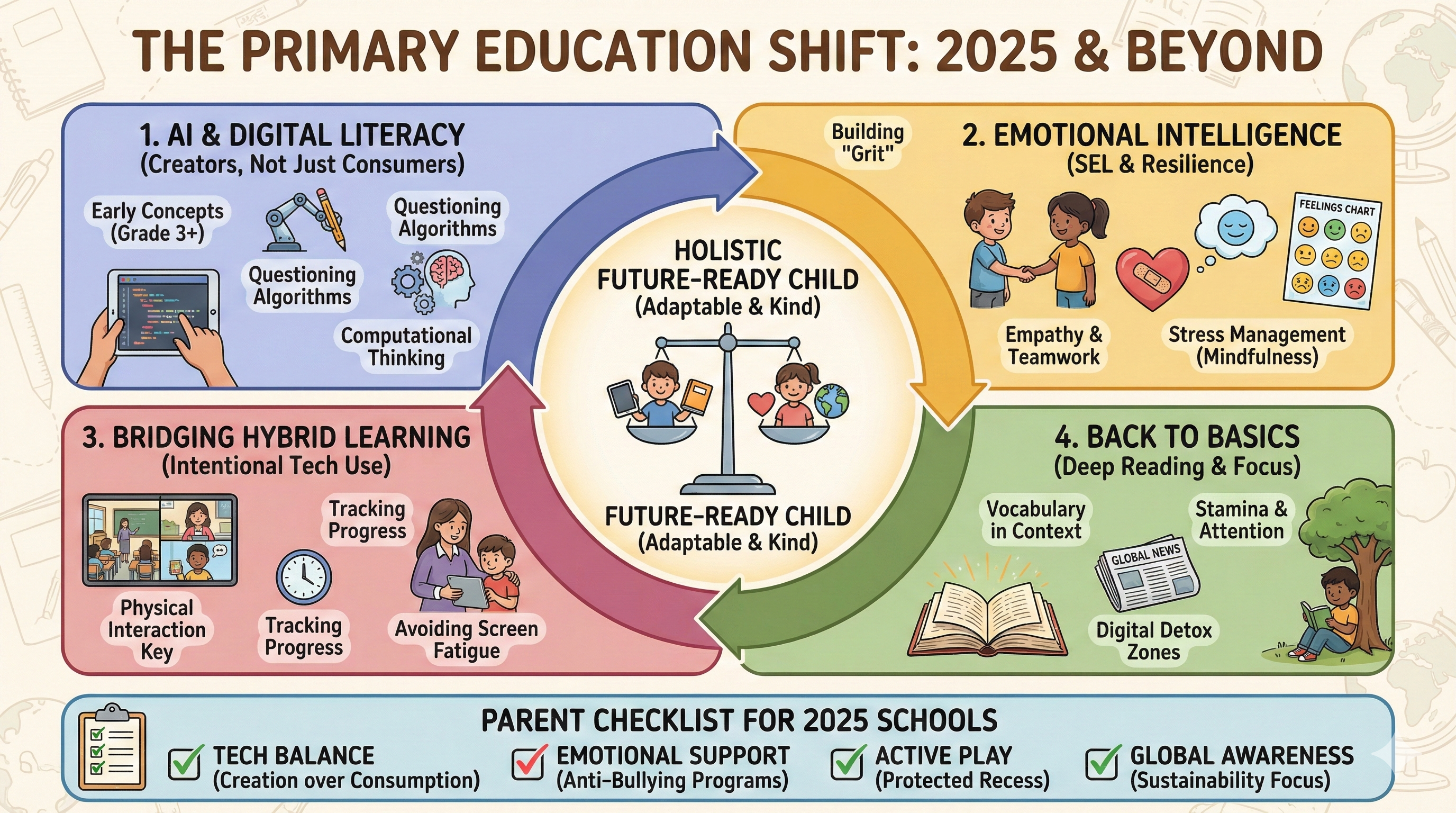
Primary Education in 2025: Global Trends Transforming the Classroom
Primary education is no longer just about reading, writing, and arithmetic. In 2025, we are witnessing a massive shift toward holistic development, where artificial intelligence meets emotional intelligence.
As we move into 2026, schools worldwide are recalibrating their curriculums to prepare children for a future that changes daily. From mandatory AI literacy to the "back-to-basics" reading movements, here is what parents and educators need to know about the current state of primary education.
1. The Rise of AI and Digital Literacy
The biggest headline in education this year is the structured integration of Artificial Intelligence (AI) into primary classrooms. It is no longer an optional "enrichment" activity; it is becoming a core discipline.
From Consumers to Creators: Schools are shifting from passive screen time to active computational thinking.
Early Implementation: Major educational boards globally are introducing AI concepts as early as Grade 3.
The Goal: The aim isn't just to use tools, but to understand how they work. Students are learning to question algorithms rather than just adapting to them.
2. Prioritizing Emotional Intelligence (SEL)
While tech is booming, there is a powerful counter-movement focusing on Social-Emotional Learning (SEL). The post-pandemic world has highlighted the need for resilience over rote memorization.
Why "Resilience" is the Buzzword of 2025
Parents and teachers are now prioritizing "grit"—the ability to bounce back from failure.
Emotion Charts: Daily check-ins to help kids label their feelings.
Conflict Resolution: Teaching empathy and teamwork as graded skills.
Stress Management: Simple breathing and mindfulness exercises are now standard in many morning assemblies.
3. Bridging the Hybrid Learning Gap
Hybrid learning (a mix of in-person and digital classes) remains a reality in many regions due to environmental factors or resource management. However, 2025 has brought a reality check: physical schooling is irreplaceable.
Key Insight: Recent data suggests that hybrid models can deepen learning gaps if not managed well. "Screen fatigue" and lack of face-to-face interaction often result in lower attention spans.
The Solution? Intentional use of technology. Schools are using apps not to replace teachers, but to track learning progress and personalize homework, freeing up classroom time for human interaction.
4. Back to Basics: The Return of Deep Reading
In a bold move to combat short attention spans caused by social media, many school systems are mandating "deep reading" time.
Newspaper Initiatives: Some regions have introduced mandatory newspaper reading sessions to build vocabulary and general awareness.
Digital Detox: "Phone-free" zones in primary schools are increasing to encourage playground play and verbal communication.
Vocabulary Building: A focus on learning words through context (stories/news) rather than memorizing lists.
Parent Checklist: Is Your Child's School Future-Ready?
[ ] Tech Balance: Do they use screens for creation (coding/art) rather than just consumption?
[ ] Emotional Support: Is there a clear program for handling bullying and mental health?
[ ] Active Play: Is recess and physical education protected from academic encroachment?
[ ] Global Awareness: Are kids learning about sustainability and world cultures?
Frequently Asked Questions (FAQs)
Q1: At what age should AI education begin?
Most experts and new 2025 curriculums suggest introducing basic computational thinking and AI concepts around age 8 (Grade 3), focusing on logic and safety rather than complex coding.
Q2: What is Social-Emotional Learning (SEL)?
SEL is the process of learning self-awareness, self-control, and interpersonal skills. It teaches children how to manage emotions and establish positive relationships.
Q3: How can I support my child's reading stamina at home?
Encourage "deep reading" by setting aside 20 minutes a day for physical books or newspapers without digital distractions. Model this behavior by reading yourself.
Q4: Is hybrid learning bad for primary students?
It can be challenging. Younger children struggle with the lack of physical interaction. If your child is in a hybrid model, ensure they have plenty of offline social time and play.
Q5: Why is sustainability becoming part of the primary curriculum?
"Eco-literacy" is growing because the next generation faces significant climate challenges. Schools are integrating sustainability into daily habits (like recycling and gardening) to normalize eco-friendly living.