Breaking the Cycle: Global Poverty Trends, New Realities, and Emerging Solutions for 2025
Poverty in 2025 is defined by complexity. While the new $3.00 line reveals a harsher reality, innovations in health and livelihood policies offer hope. To truly eradicate poverty, the world must move beyond monetary aid and address the root causes: conflict, climate, and systemic inequality.
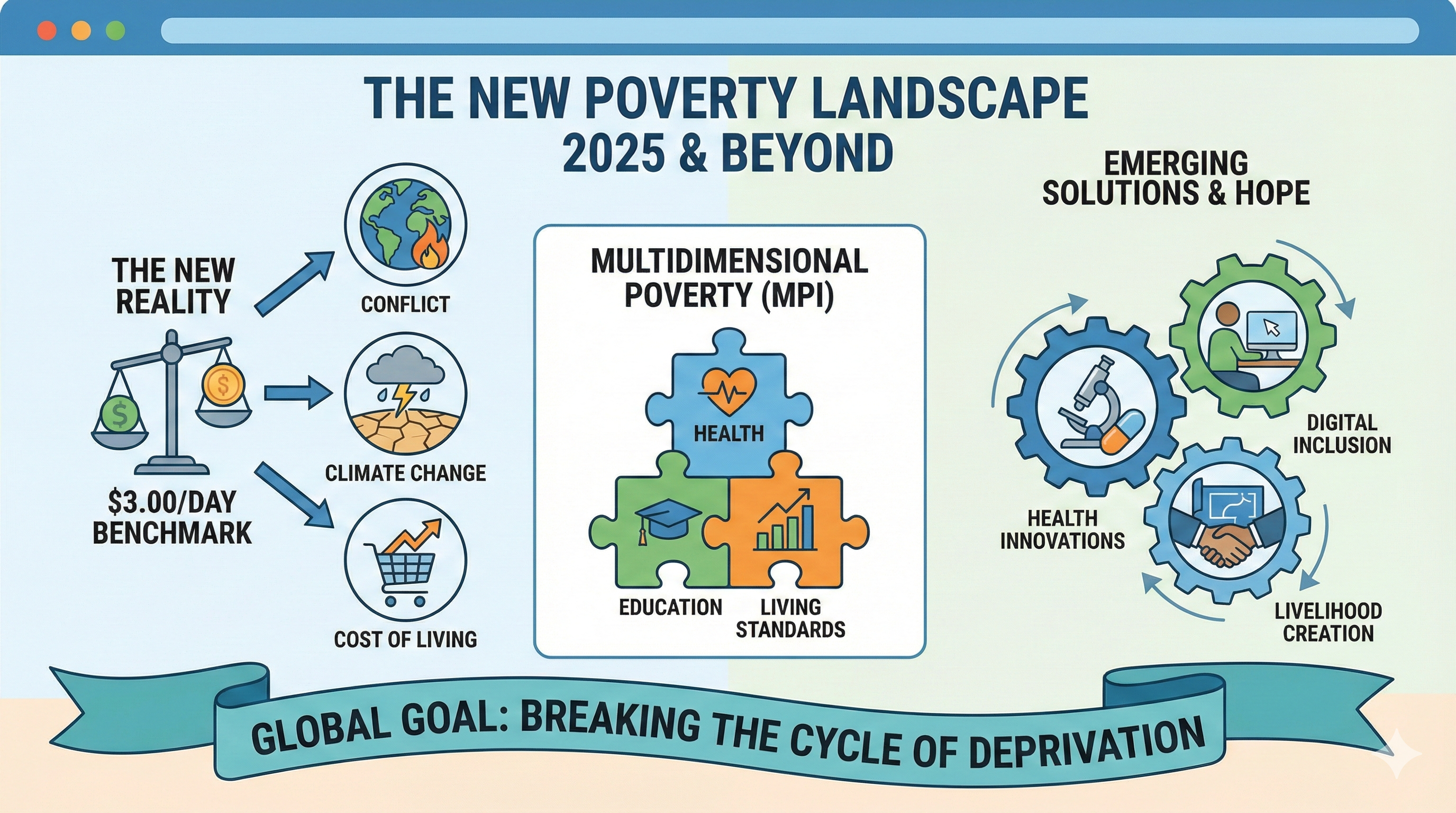
The Changing Face of Global Poverty in 2025
Poverty is no longer just about a lack of money; it is a complex web of conflict, climate change, and economic instability. As we move into 2025, the global definition of what it means to be "poor" has shifted, and so have the strategies to combat it.
The World Bank has updated the international poverty line, and recent data reveals that while some regions are recovering from post-pandemic shocks, others are falling further behind. Understanding these new dynamics is crucial for policymakers, NGOs, and global citizens alike.
The New Reality: $3.00 is the New Benchmark
For years, the world measured extreme poverty at $2.15 per day. However, due to inflation and purchasing power changes, the World Bank effectively raised the benchmark to $3.00 per day (2021 PPP) in mid-2025.
Global Rates: Approximately 10.3% of the global population lived in extreme poverty in 2024, with projections dipping slightly to 10.1% in 2025.
The Struggle: This adjustment means millions more are now statistically classified as living in extreme poverty, reflecting the rising cost of basic survival.
Regional Disparity: Poverty is increasingly concentrated in Sub-Saharan Africa, where nearly 46% of the population lives below the poverty line.
Why Poverty Persists: The "Three Cs"
Despite technological advancements, three major forces are stalling progress:
Conflict:
War zones are now the epicenter of deprivation.
Over 1.1 billion people live in multidimensional poverty, with a disproportionate number residing in conflict-affected areas.
Instability disrupts supply chains, destroys infrastructure, and prevents aid from reaching those in need.
Climate Change:
Extreme weather events drive families into destitution by destroying crops and homes.
Climate-induced inflation pushes food prices beyond the reach of the vulnerable.
Cost of Living:
Global inflation has eroded wages, meaning even those with jobs struggle to afford essential services like healthcare and education.
Beyond Income: The Multidimensional Poverty Index (MPI)
Money tells only half the story. The Multidimensional Poverty Index (MPI) looks at deprivations in health, education, and living standards.
Health: Lack of access to clean water, nutrition, and basic medicines.
Education: Children forced to leave school to work.
Living Standards: Inadequate housing, no electricity, and poor sanitation.
In 2024-2025, data shows that acute deprivation in housing and cooking fuel remains a massive barrier, affecting over a billion people globally.
Emerging Solutions and Hope
The fight against poverty is evolving from simple "welfare" to "livelihood creation."
Health Innovations: New breakthroughs, such as the Lenacapavir HIV-prevention drug and efficient malaria treatments, are reducing the disease burden that keeps families poor.
Policy Shifts: Nations like India are pivoting from job guarantee schemes to "livelihood creation" models (e.g., VBGRAMG), focusing on building infrastructure that generates long-term income.
Digital Inclusion: Expanding internet access to rural areas is allowing remote work and digital banking, bypassing traditional economic hurdles.
Fast Facts: Global Poverty 2025
Extreme Poverty Line: Updated to roughly $3.00/day.
Hardest Hit Region: Sub-Saharan Africa (approx. 89% live in poverty at the higher $8.30 line).
Key Driver: Violent conflict is the primary cause of acute hunger and deprivation.
Global Goal: The UN Sustainable Development Goal (SDG) of ending poverty by 2030 is currently off track but recoverable with targeted action.
Frequently Asked Questions (FAQs)
1. What is the current global poverty line?
As of late 2025 updates, the World Bank's international poverty line used for global comparison has shifted from the old $2.15 standard to $3.00 per day (2021 PPP) to account for inflation and cost of living changes.
2. Which region has the highest poverty rate in 2025?
Sub-Saharan Africa remains the region with the highest concentration of extreme poverty, with rates hovering around 46%. Conflict and political instability are major contributing factors.
3. What is Multidimensional Poverty?
Multidimensional poverty measures deprivation beyond just income. It considers poor health, lack of education, inadequate living standards, disempowerment, and the threat of violence.
4. How does climate change affect poverty?
Climate change acts as a "threat multiplier." It destroys agricultural livelihoods, increases food prices, and forces migration, often pushing vulnerable populations deeper into poverty.
5. What is the most effective solution to poverty right now?
Experts suggest a mix of peace-building in conflict zones, investment in human capital (health and education), and shifting from temporary aid to sustainable livelihood creation (jobs and infrastructure).