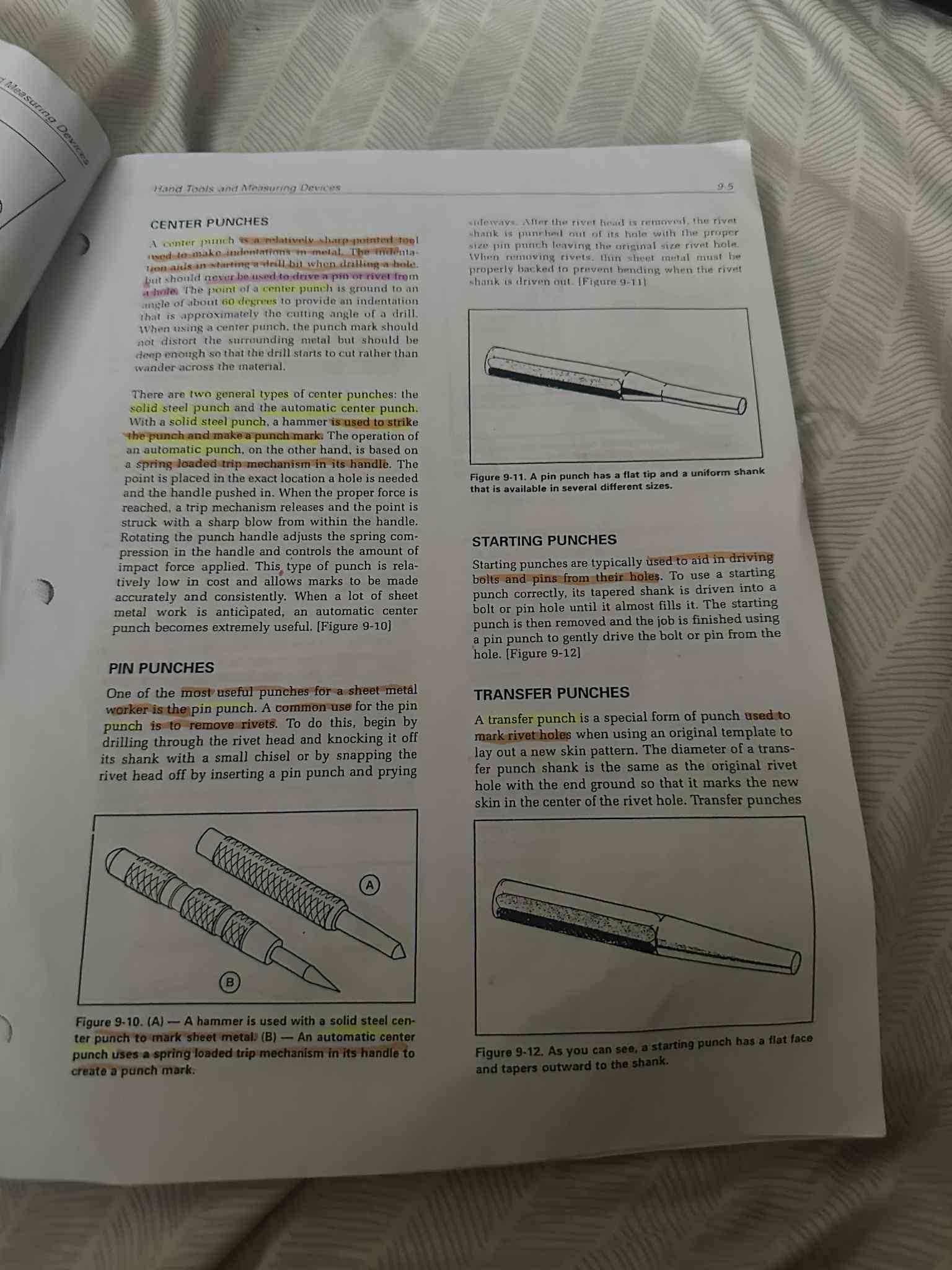
Learn to distinguish between different types of punches, such as center, pin, and starting punches. This guide covers their primary uses in metalwork, from marking drill holes to removing rivets.
Pages: 4Questions per page: 10
Rate this quiz
☆☆☆☆☆
Avg: 0.00 ( 0 )
Score: 0Page 1 / 4
1. What is the recommended point angle for a center punch to properly aid in starting a drill bit?
Explanation: The text under 'CENTER PUNCHES' states, 'The point of a center punch is ground to an angle of about 60 degrees to provide an indentation that is approximately the cutting angle of a drill.'
2. According to the text, which type of punch should be used to mark rivet holes when using a template to create a new pattern?
Explanation: The 'TRANSFER PUNCHES' section specifies that a transfer punch is 'used to mark rivet holes when using an original template to lay out a new skin pattern.'
3. What is the primary operational difference between the two center punches shown in Figure 9-10?
Explanation: The caption for Figure 9-10 explains that (A) is a solid steel center punch used with a hammer, and (B) is an automatic center punch that uses an internal spring-loaded mechanism.
4. What is a common use for a pin punch, as described in the document?
Explanation: The section 'PIN PUNCHES' begins by stating, 'A common use for the pin punch is to remove rivets.'
5. The text explicitly warns that a center punch should NEVER be used for which task?
Explanation: In the first paragraph under 'CENTER PUNCHES', the text clearly states it 'should never be used to drive a pin or rivet from a hole.'
6. Which punch is characterized by a flat face and a shank that tapers outward, and is used to initially drive bolts and pins?
Explanation: The 'STARTING PUNCHES' section and the caption for Figure 9-12 describe a starting punch as having a flat face and a tapered shank, used to aid in driving bolts and pins.
7. How is the impact force of an automatic center punch controlled?
Explanation: The text states, 'Rotating the punch handle adjusts the spring compression in the handle and controls the amount of impact force applied.'
8. When removing a stubborn pin, which two punches are often used in sequence?
Explanation: The text on Starting Punches says its tapered shank is driven into the hole first. 'The starting punch is then removed and the job is finished using a pin punch to gently drive the bolt or pin from the hole.'
9. What are the physical characteristics of the pin punch shown in Figure 9-11?
Explanation: The caption for Figure 9-11 directly states, 'A pin punch has a flat tip and a uniform shank...'
10. What is the primary function of a center punch?
Explanation: The text describes a center punch as a 'tool used to make indentations in metal. The indentation aids in starting a drill bit when drilling a hole.'
11. According to the text, what is the primary safety precaution that must be taken when using any punch?
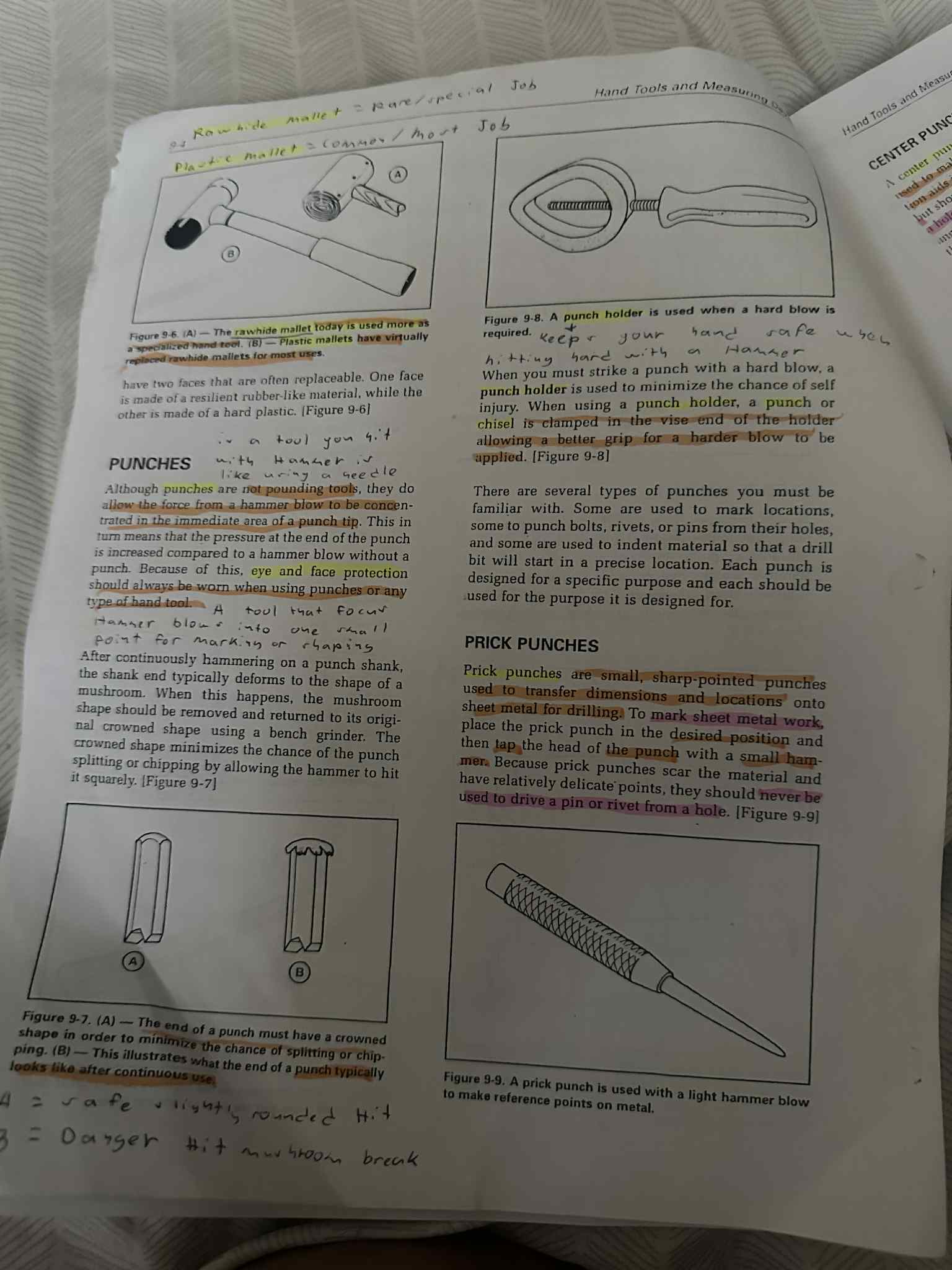
Explanation: The text states, '...eye and face protection should always be worn when using punches or any type of hand tool.'
12. What is the condition called when the end of a punch deforms into the shape shown in Figure 9-7 (B) after continuous use?
Explanation: The text describes this deformation: '...the shank end typically deforms to the shape of a mushroom.' Figure 9-7 (B) illustrates this.
13. What is the primary purpose of a prick punch as shown in Figure 9-9?
Explanation: The text under 'Prick Punches' states they are 'used to transfer dimensions and locations onto sheet metal for drilling.' The caption for Figure 9-9 also mentions it's used 'to make reference points on metal.'
14. Why should a prick punch NEVER be used to drive a pin or rivet?
Explanation: The text warns that because prick punches have 'relatively delicate points, they should never be used to drive a pin or rivet from a hole.'
15. Under what circumstance is a punch holder (Figure 9-8) specifically recommended for use?
Explanation: The caption for Figure 9-8 and the following paragraph state that a punch holder is used 'when a hard blow is required' to minimize the chance of self-injury.
16. What is the primary advantage of using a punch compared to a direct hammer blow?
Explanation: The text explains that punches 'allow the force from a hammer blow to be concentrated in the immediate area of a punch tip. This in turn means that the pressure at the end of the punch is increased...'
17. According to the caption for Figure 9-6, how has the usage of mallets changed?
Explanation: The caption for Figure 9-6 (B) states, 'Plastic mallets have virtually replaced rawhide mallets for most uses.'
18. What is the correct procedure for fixing a punch that has become mushroomed?
Explanation: The text states: '...the mushroom shape should be removed and returned to its original crowned shape using a bench grinder.'
19. Which illustration in Figure 9-7 shows the safe, correct shape for the end of a punch?
Explanation: The caption for Figure 9-7 (A) states, 'The end of a punch must have a crowned shape in order to minimize the chance of splitting or chipping.'
20. According to Figure 9-2, what distinguishes a cross peen hammer from a straight peen hammer?
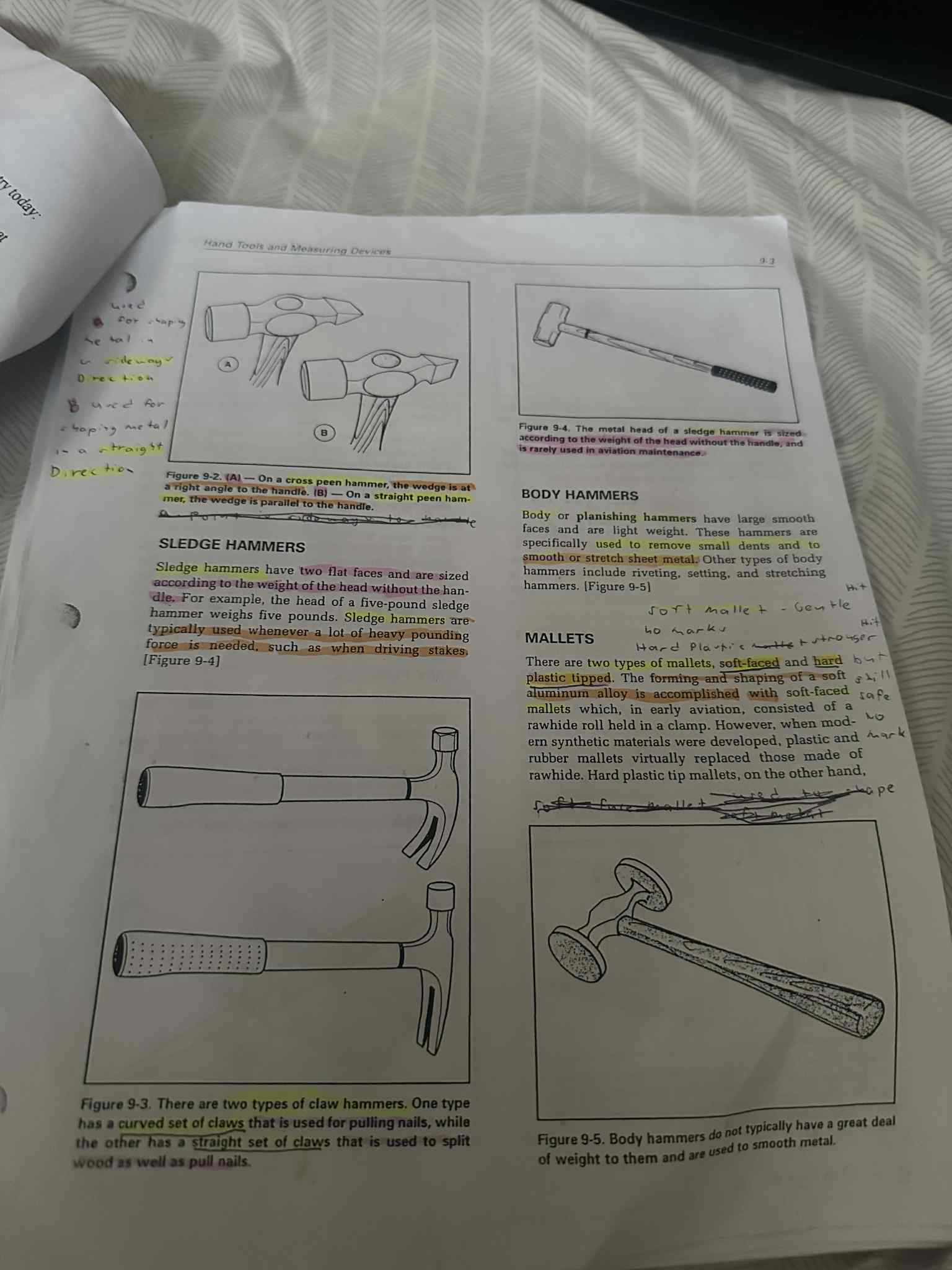
Explanation: The caption for Figure 9-2 states that on a cross peen hammer, the wedge is at a right angle to the handle, while on a straight peen hammer, the wedge is parallel to the handle.
21. How are sledge hammers sized?
Explanation: The text under the 'SLEDGE HAMMERS' section explicitly states they 'are sized according to the weight of the head without the handle.'
22. What is the primary purpose of a claw hammer with a curved set of claws, as described in Figure 9-3?
Explanation: The caption for Figure 9-3 specifies that the type with a 'curved set of claws is used for pulling nails.'
23. Body hammers, also known as planishing hammers, are specifically designed for which task?
Explanation: The text under 'BODY HAMMERS' mentions they are 'specifically used to remove small dents and to smooth or stretch sheet metal.'
24. For forming and shaping soft aluminum alloy, which type of tool is recommended?
Explanation: The section on 'MALLETS' states, 'The forming and shaping of a soft aluminum alloy is accomplished with soft-faced mallets.'
25. Which of the following tasks is a typical use for a sledge hammer?
Explanation: The text indicates that sledge hammers are used 'whenever a lot of heavy pounding force is needed, such as when driving stakes.'
26. In addition to pulling nails, what is a specific use for a claw hammer with a straight set of claws?
Explanation: The caption for Figure 9-3 notes that the straight set of claws 'is used to split wood as well as pull nails.'
27. What material were early soft-faced mallets, used in aviation, commonly made from?
Explanation: The 'MALLETS' section mentions that early mallets 'consisted of a rawhide roll held in a clamp,' which was later replaced by modern materials.
28. What are the key physical characteristics of body hammers according to the text?
Explanation: The text describes body hammers as having 'large smooth faces and are light weight.' Figure 9-5's caption reinforces this.
29. What is a notable limitation mentioned about the use of sledge hammers in Figure 9-4?
Explanation: The caption for Figure 9-4, which shows a sledge hammer, concludes by stating that it 'is rarely used in aviation maintenance.'
30. According to the text, what is the first safety precaution you should take before using any hammer or mallet?
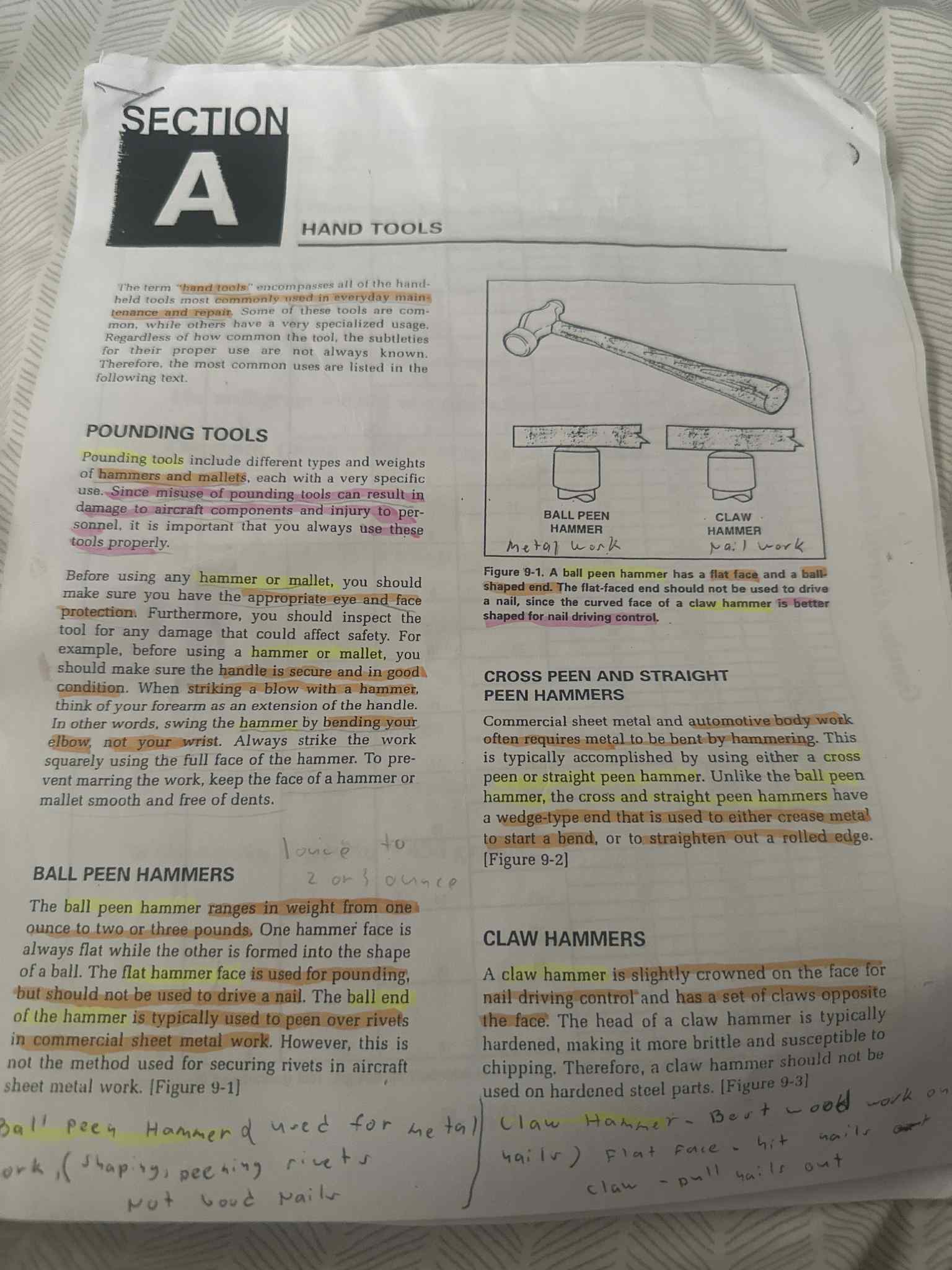
Explanation: The text explicitly states: 'Before using any hammer or mallet, you should make sure you have the appropriate eye and face protection.'
31. What is the ball end of a ball peen hammer typically used for in commercial sheet metal work?
Explanation: The text under 'BALL PEEN HAMMERS' says, 'The ball end of the hammer is typically used to peen over rivets in commercial sheet metal work.'
32. Why should a claw hammer not be used on hardened steel parts?
Explanation: The 'CLAW HAMMERS' section states, 'The head of a claw hammer is typically hardened, making it more brittle and susceptible to chipping. Therefore, a claw hammer should not be used on hardened steel parts.'
33. What is the primary purpose of the wedge-type end on a cross peen or straight peen hammer?
Explanation: The text explains that cross and straight peen hammers have a 'wedge-type end that is used to either crease metal to start a bend, or to straighten out a rolled edge.'
34. Based on the text and Figure 9-1, which hammer is better suited for nail driving and why?
Explanation: The caption for Figure 9-1 says, '...the curved face of a claw hammer is better shaped for nail driving control.' The text also notes a claw hammer is 'slightly crowned on the face for nail driving control'.
35. What is the correct technique for swinging a hammer, as described in the text?
Explanation: The 'POUNDING TOOLS' section instructs the user to '...swing the hammer by bending your elbow, not your wrist.'
36. What is the typical weight range for a ball peen hammer according to the provided text?
Explanation: The first sentence under 'BALL PEEN HAMMERS' states, 'The ball peen hammer ranges in weight from one ounce to two or three pounds.'
37. To prevent marring your work, what condition should the face of a hammer or mallet be in?
Explanation: The text advises, 'To prevent marring the work, keep the face of a hammer or mallet smooth and free of dents.'
38. Which hammer features one flat face for pounding and another face shaped like a ball?
Explanation: The description under 'BALL PEEN HAMMERS' reads: 'One hammer face is always flat while the other is formed into the shape of a ball.'
39. The misuse of pounding tools can result in which of the following consequences mentioned in the text?
Explanation: The 'POUNDING TOOLS' section warns, 'Since misuse of pounding tools can result in damage to aircraft components and injury to personnel, it is important that you always use these tools properly.'