Aquatic Plant Support Systems
Test your knowledge on the different types of aquatic plants and the unique adaptations, like air sacs, that help them float and get sunlight.
Pages: 10 Questions per page: 7
Rate this quiz
Avg: 0.00 ( 0 )
Score: 0
Page 1 / 10
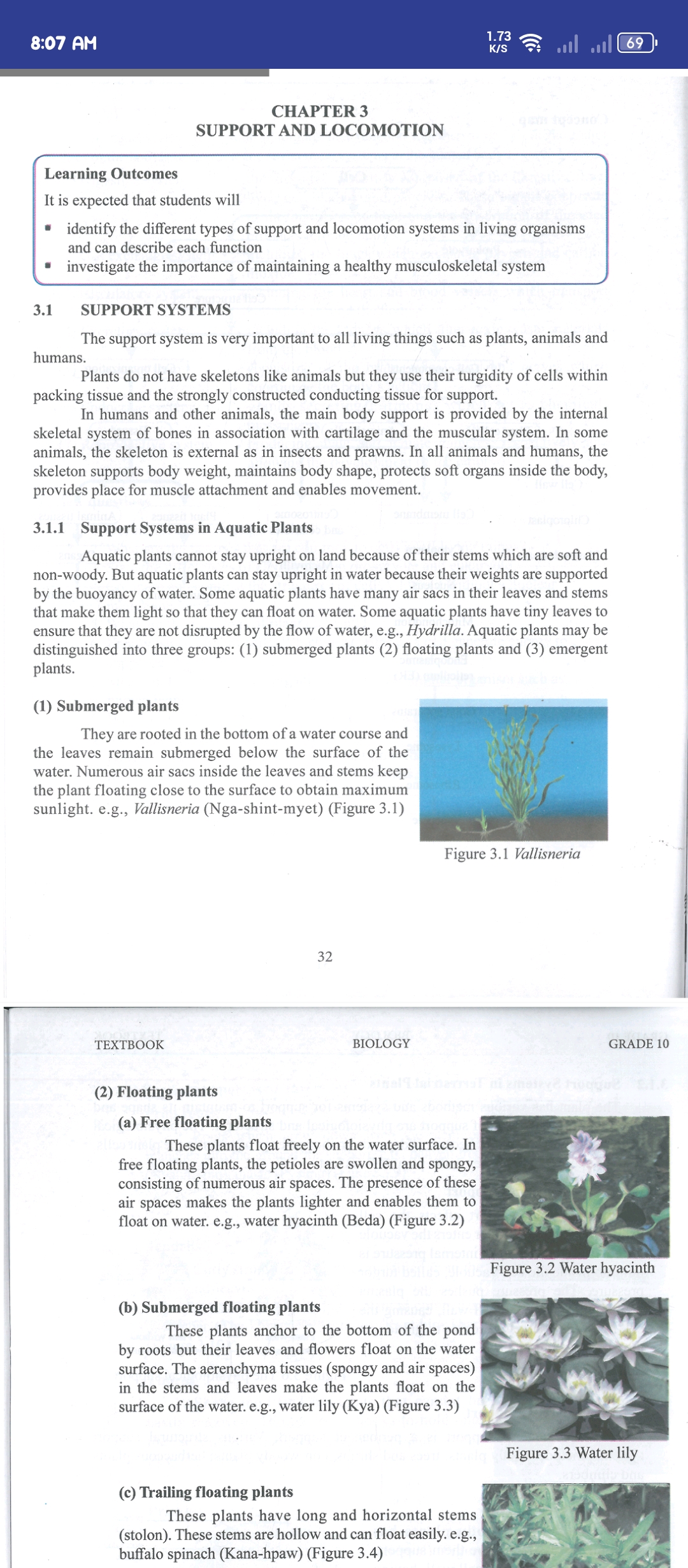
1. What is the primary mechanism that allows aquatic plants with soft stems to stay upright in water?
Explanation: The text states, 'aquatic plants can stay upright in water because their weights are supported by the buoyancy of water.'
2. Which feature is common in aquatic plants like Vallisneria, water hyacinth, and water lily to aid in floating?
Explanation: The text mentions 'numerous air sacs' for submerged plants, 'numerous air spaces' in the petioles of free-floating plants, and 'aerenchyma tissues (spongy and air spaces)' for submerged floating plants, all serving to help the plant float.
3. A plant is observed to float freely on the water's surface, with swollen and spongy petioles. Which type of plant is it?
Explanation: According to the text, free-floating plants, like the water hyacinth, 'float freely on the water surface' and have 'petioles [that] are swollen and spongy, consisting of numerous air spaces.'
4. Which of the following plants is described as being anchored to the bottom by roots while its leaves and flowers float on the surface?
Explanation: The text identifies the water lily (Kya) as a 'submerged floating plant' that 'anchor[s] to the bottom of the pond by roots but their leaves and flowers float on the water surface.'
5. What is the key characteristic of trailing floating plants, such as buffalo spinach?
Explanation: The section on trailing floating plants explicitly states, 'These plants have long and horizontal stems (stolon). These stems are hollow and can float easily.'
6. In submerged plants like Vallisneria, what is the main purpose of having air sacs?
Explanation: The text about submerged plants says that 'Numerous air sacs inside the leaves and stems keep the plant floating close to the surface to obtain maximum sunlight.'
7. How do plants primarily gain support on land, as contrasted with aquatic plants in water?
Explanation: The text states that plants on land 'use their turgidity of cells within packing tissue and the strongly constructed conducting tissue for support,' which is different from the buoyancy that supports aquatic plants.
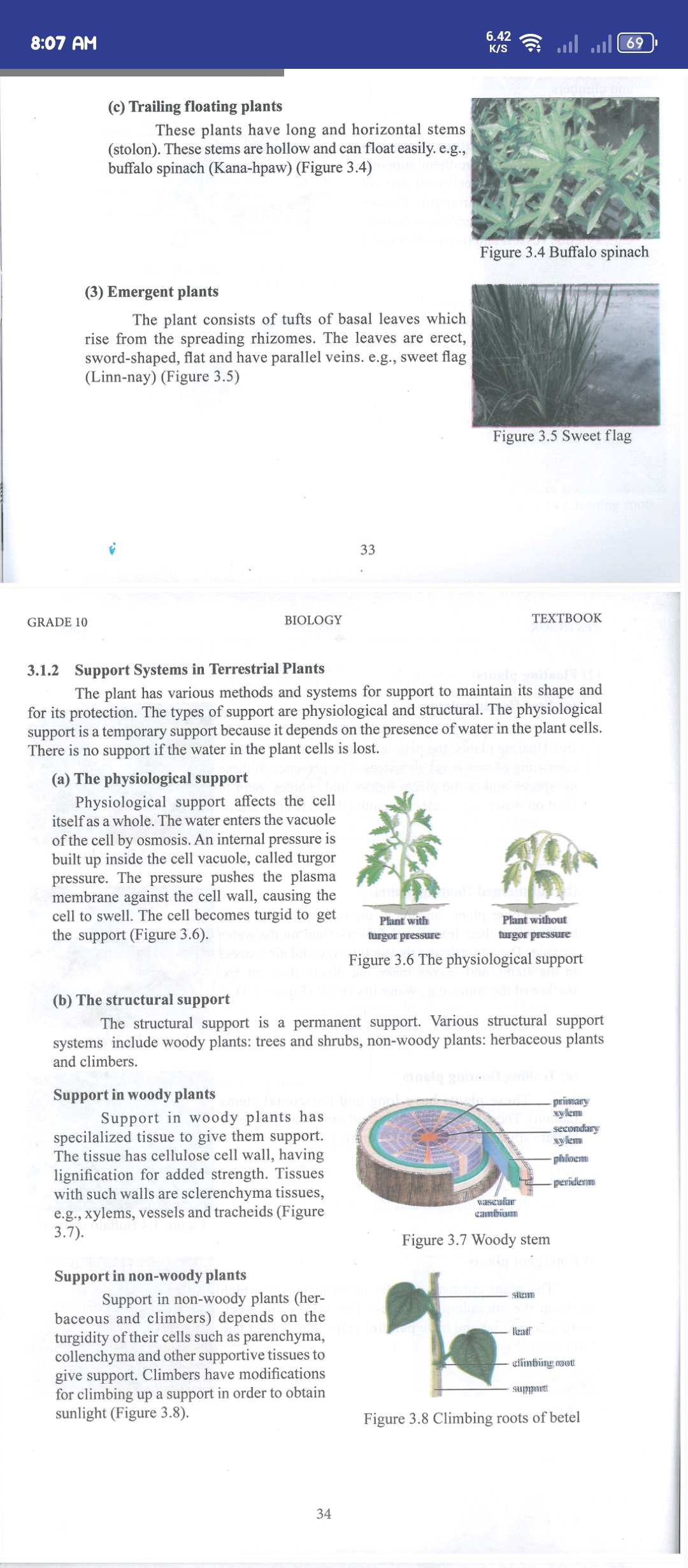
8. According to the text, what is the primary cause of physiological support in terrestrial plants?
Explanation: The section '(a) The physiological support' states that water enters the cell's vacuole by osmosis, creating an internal pressure called turgor pressure, which pushes against the cell wall and provides support.
9. Which of the following best describes a key difference between physiological and structural support in plants?
Explanation: The text explains that physiological support is temporary and depends on water, whereas structural support is a permanent system involving specialized tissues like sclerenchyma and xylem.
10. Based on the description, what is a characteristic feature of 'Trailing floating plants' like the Buffalo spinach in Figure 3.4?
Explanation: The text under section '(c) Trailing floating plants' explicitly states that these plants have long, horizontal, and hollow stems (stolons) that allow them to float easily.
11. What happens to a plant when it lacks turgor pressure, as illustrated by the wilted plant in Figure 3.6?
Explanation: Figure 3.6 visually contrasts a plant with turgor pressure (erect) and one without (wilted). The text explains that without turgor pressure, the cell is no longer turgid, leading to a loss of support for the plant.
12. Support in woody plants is provided by specialized tissues. Which of the following is NOT listed as a supportive tissue for woody plants?
Explanation: The section 'Support in woody plants' mentions sclerenchyma tissues, xylem, vessels, and tracheids. Parenchyma is mentioned under 'Support in non-woody plants' as a tissue whose turgidity provides support.
13. How do non-woody plants, such as climbers, primarily achieve support?
Explanation: The text under 'Support in non-woody plants' states that their support 'depends on the turgidity of their cells such as parenchyma, collenchyma and other supportive tissues'.
14. Which plant type is characterized by tufts of basal leaves rising from spreading rhizomes, as seen with the sweet flag in Figure 3.5?
Explanation: The description for '(3) Emergent plants' says they consist of 'tufts of basal leaves which rise from the spreading rhizomes,' which matches the description and the example of the sweet flag.
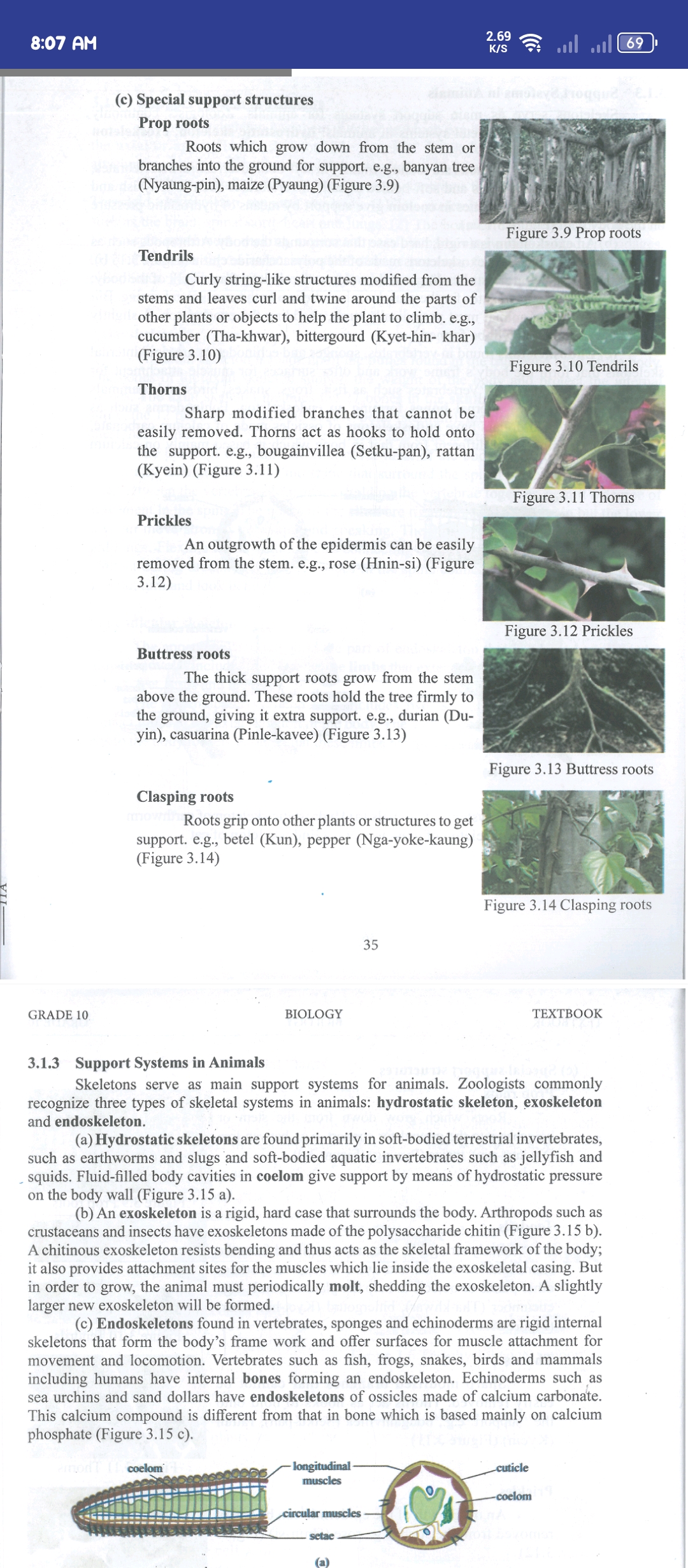
15. According to the text, what is the primary difference between thorns and prickles?
Explanation: The textbook explicitly states that thorns are 'modified branches that cannot be easily removed,' whereas prickles are 'an outgrowth of the epidermis' that 'can be easily removed from the stem.'
16. Which type of plant support structure is described as thick roots growing from the stem above the ground to hold a tree firmly, with durian and casuarina given as examples?
Explanation: The text defines buttress roots as 'The thick support roots grow from the stem above the ground. These roots hold the tree firmly to the ground,' and lists durian and casuarina as examples.
17. Which of the following animal groups is described as having a hydrostatic skeleton?
Explanation: The section on hydrostatic skeletons states they are 'found primarily in soft-bodied terrestrial invertebrates such as earthworms and slugs and soft-bodied aquatic invertebrates such as jellyfish and squids.'
18. What is a key characteristic of an exoskeleton, as mentioned in the text?
Explanation: The text describes an exoskeleton as a 'rigid, hard case' made of 'chitin' and notes that 'in order to grow, the animal must periodically molt, shedding the exoskeleton.'
19. The textbook distinguishes between the endoskeletons of vertebrates and echinoderms. What are their respective primary chemical compositions?
Explanation: The text states that vertebrate bones are 'based mainly on calcium phosphate' and that echinoderms have endoskeletons 'of ossicles made of calcium carbonate.'
20. A plant is observed with curly, string-like structures that are coiling around a fence to help it climb. Based on the provided text, what are these structures called?
Explanation: Tendrils are defined as 'Curly string-like structures modified from the stems and leaves [that] curl and twine around the parts of other plants or objects to help the plant to climb.'
21. Based on the information provided, what type of skeleton would a crab, which is a crustacean, possess?
Explanation: The text clearly states that 'Arthropods such as crustaceans and insects have exoskeletons.' Since a crab is a crustacean, it has an exoskeleton.
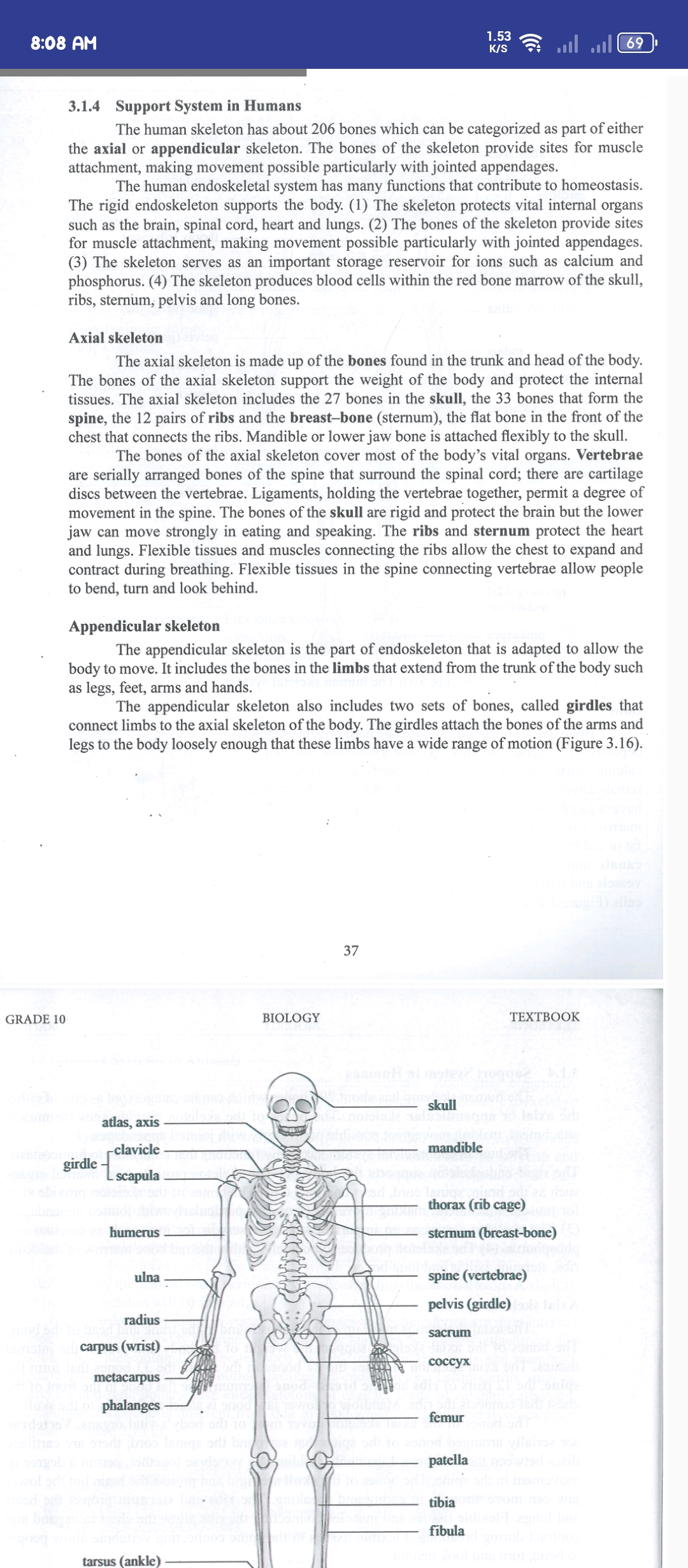
22. According to the text, the human skeleton is primarily categorized into which two parts?
Explanation: The first paragraph of section 3.1.4 explicitly states that the human skeleton can be categorized as part of either the 'axial or appendicular skeleton'.
23. Which of the following is NOT a function of the human endoskeletal system as described in the text?
Explanation: The text lists four functions: support and protection, providing sites for muscle attachment, ion storage, and blood cell production. Hormone production is not mentioned as a function of the skeletal system.
24. Which of these bone groups belongs to the axial skeleton?
Explanation: The section on the Axial skeleton states that it includes the skull, the spine, the 12 pairs of ribs, and the breast-bone (sternum). The other options list bones of the appendicular skeleton.
25. Based on the provided diagram, which labeled bone is part of the appendicular skeleton?
Explanation: The appendicular skeleton consists of the limbs and girdles. The femur is the thigh bone, which is part of the leg (a limb). The skull, spine, and sternum are all parts of the axial skeleton.
26. What is the primary role of the girdles, such as the pelvis and the combination of the clavicle and scapula?
Explanation: The text under 'Appendicular skeleton' states that it 'includes two sets of bones, called girdles that connect limbs to the axial skeleton of the body'.
27. The text states that the bones of the axial skeleton, such as the vertebrae, cover most of the body's vital organs. What specific vital structure do the vertebrae surround and protect?
Explanation: In the 'Axial skeleton' section, the text says, 'Vertebrae are serially arranged bones of the spine that surround the spinal cord'.
28. In the diagram, the humerus, radius, and ulna form the arm. These bones are part of which division of the skeleton?
Explanation: The appendicular skeleton is defined as the part that includes the bones in the limbs, such as arms and legs. The humerus, radius, and ulna are the bones of the arm.
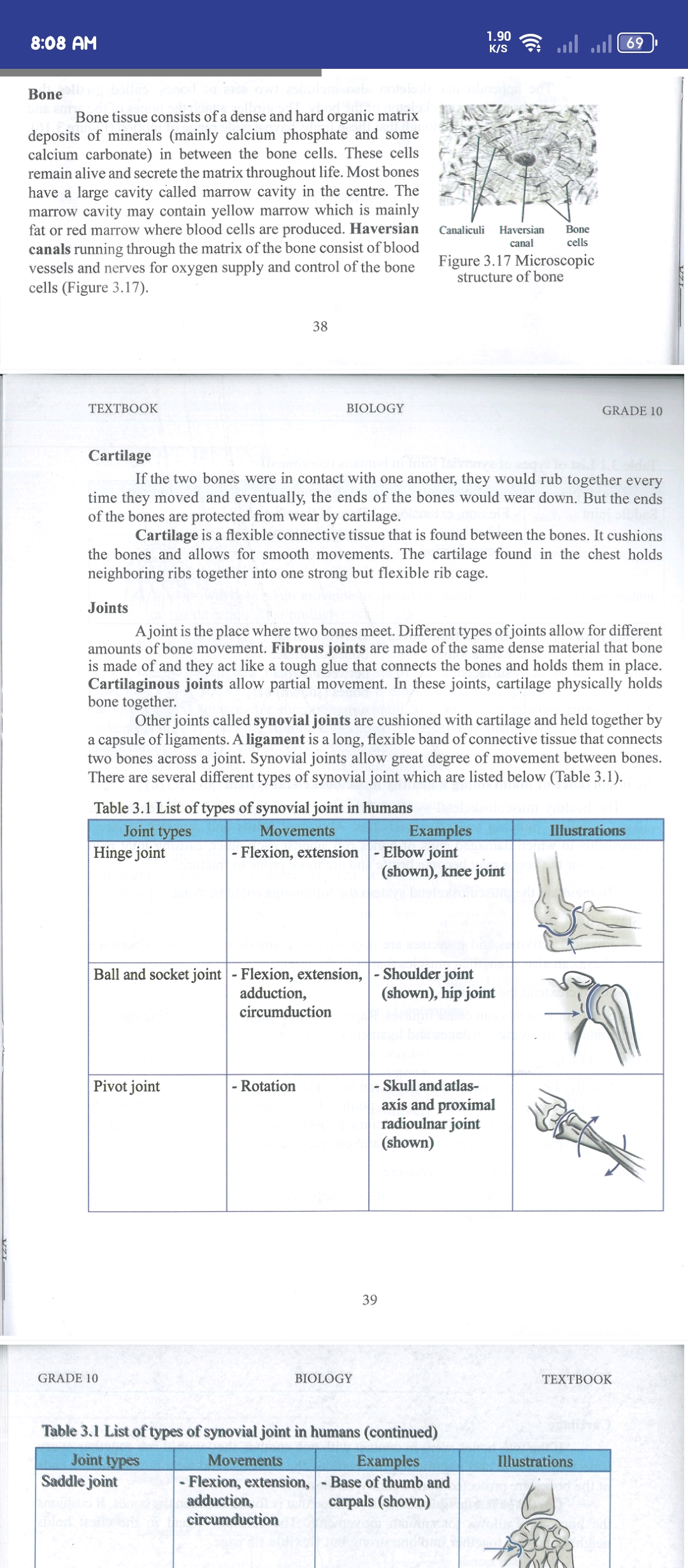
29. According to the text, what is the primary function of red bone marrow?
Explanation: The text states that the marrow cavity may contain 'red marrow where blood cells are produced.'
30. What is the role of the Haversian canals in bone tissue?
Explanation: The text describes that 'Haversian canals running through the matrix of the bone consist of blood vessels and nerves for oxygen supply and control of the bone cells.'
31. What type of tissue is found at the ends of bones to prevent wear and allow for smooth movement?
Explanation: The text explains that 'the ends of the bones are protected from wear by cartilage' and that cartilage 'allows for smooth movements.'
32. Which type of joint allows for the greatest degree of movement between bones?
Explanation: The passage states, 'Synovial joints allow great degree of movement between bones,' while fibrous joints act as glue and cartilaginous joints allow only partial movement.
33. Based on Table 3.1, which of the following is an example of a hinge joint?
Explanation: Table 3.1 clearly lists the 'Elbow joint' and 'knee joint' as examples of a hinge joint, which allows for flexion and extension.
34. What type of movement is characteristic of a pivot joint, such as the one between the skull and atlas?
Explanation: In Table 3.1, the 'Movements' column for the 'Pivot joint' is listed as 'Rotation'.
35. Which type of synovial joint allows for flexion, extension, adduction, abduction, and circumduction?
Explanation: Table 3.1 specifies that the 'Ball and socket joint' is capable of 'Flexion, extension, adduction, abduction, circumduction.'
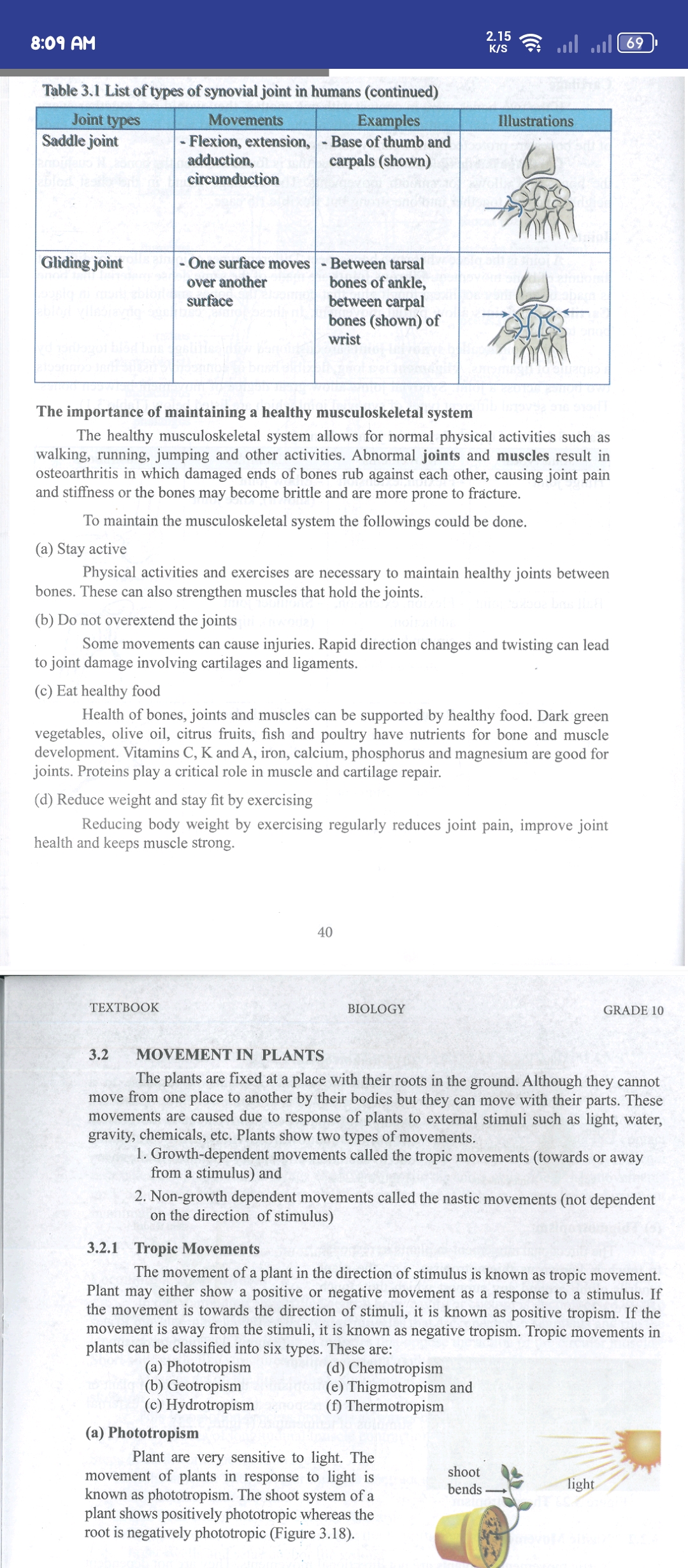
36. According to Table 3.1, what type of joint is found between the carpal bones of the wrist?
Explanation: The table lists 'between carpal bones (shown) of wrist' as an example of a Gliding joint.
37. Which of the following movements is associated with a Saddle joint as described in the provided text?
Explanation: The 'Movements' column for the Saddle joint lists flexion, extension, adduction, and circumduction.
38. Based on the text, what is the term for a plant's growth movement towards or away from a directional stimulus like light?
Explanation: The section 'Tropic Movements' defines this as 'The movement of a plant in the direction of stimulus'.
39. How does the shoot system of a plant exhibit phototropism?
Explanation: The text under 'Phototropism' states that 'The shoot system of a plant shows positively phototropic' behavior.
40. Which nutrient is mentioned as playing a 'critical role in muscle and cartilage repair'?
Explanation: In the section '(c) Eat healthy food', the text explicitly says, 'Proteins play a critical role in muscle and cartilage repair'.
41. What is described as a 'non-growth dependent' plant movement that is 'not dependent on the direction of stimulus'?
Explanation: The introductory text on plant movement distinguishes between tropic movements and 'Non-growth dependent movements called the nastic movements (not dependent on the direction of stimulus)'.
42. According to the section on maintaining a healthy musculoskeletal system, what is a direct benefit of reducing body weight through exercise?
Explanation: The text under point (d) states, 'Reducing body weight by exercising regularly reduces joint pain, improve joint health and keeps muscle strong'.
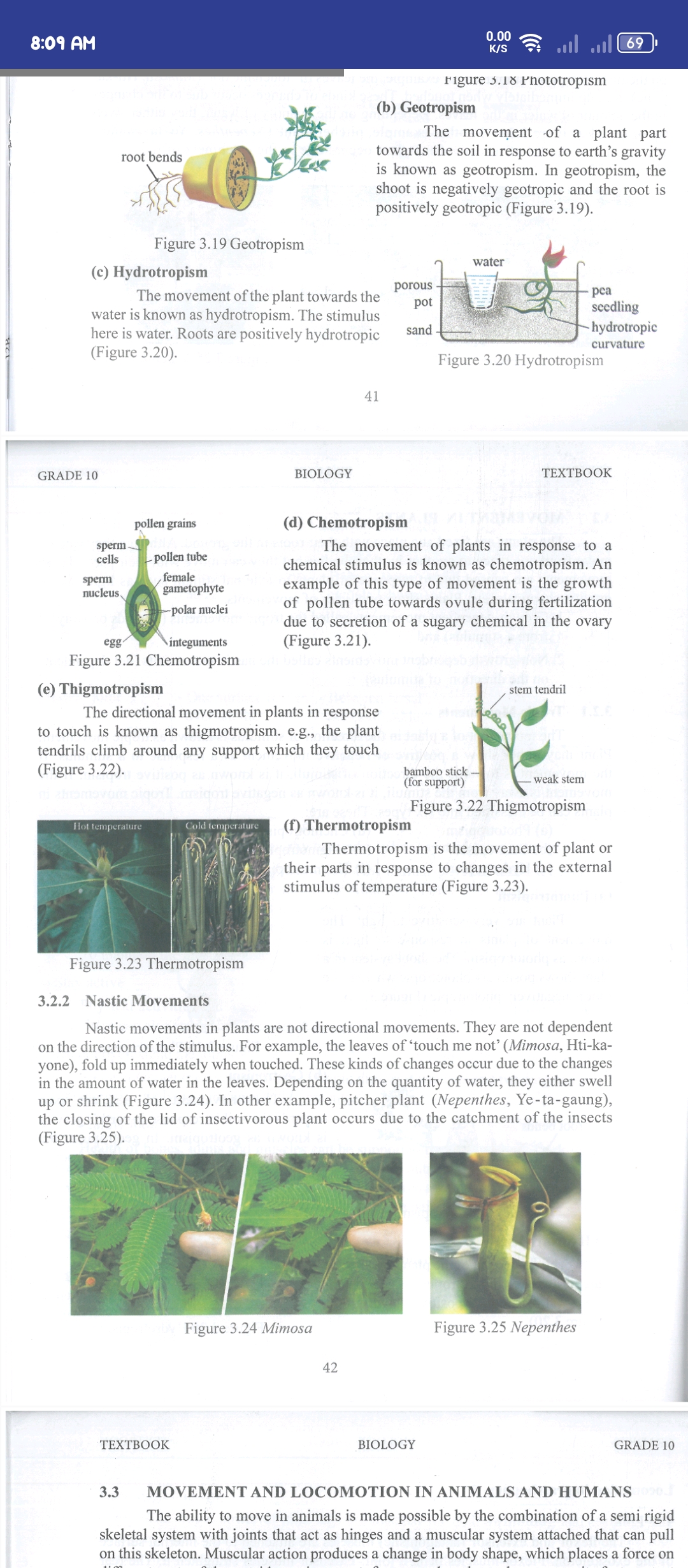
43. According to the text and Figure 3.19, which statement correctly describes geotropism in plants?
Explanation: The text under section (b) Geotropism explicitly states: 'In geotropism, the shoot is negatively geotropic and the root is positively geotropic'. This means the shoot grows away from gravity, and the root grows towards it.
44. The movement of a plant tendril coiling around a support structure like a bamboo stick, as shown in Figure 3.22, is an example of what?
Explanation: Section (e) Thigmotropism defines this as 'The directional movement in plants in response to touch' and provides the example of plant tendrils climbing around any support they touch.
45. What is the key difference between tropisms (like geotropism, hydrotropism) and nastic movements?
Explanation: Section 3.2.2 on Nastic Movements clearly states that they 'are not directional movements. They are not dependent on the direction of the stimulus,' which distinguishes them from tropisms.
46. Based on the description of Chemotropism (Figure 3.21), what stimulates the growth of the pollen tube towards the ovule?
Explanation: The text for section (d) Chemotropism gives a specific example: '...growth of pollen tube towards ovule during fertilization due to secretion of a sugary chemical in the ovary.'
47. The folding of the leaves of a Mimosa plant when touched (Figure 3.24) is categorized as what type of plant movement?
Explanation: The text under Nastic Movements uses the Mimosa ('touch me not') plant as a primary example, noting that its leaves 'fold up immediately when touched' as a non-directional response.
48. What type of tropism is being demonstrated by the pea seedling's root in Figure 3.20?
Explanation: Figure 3.20 and the accompanying text explain hydrotropism, 'The movement of the plant towards the water.' The image shows the root exhibiting 'hydrotropic curvature' towards the water in the porous pot.
49. The response of plant parts to changes in temperature, such as the leaves shown in Figure 3.23, is known as:
Explanation: Section (f) defines Thermotropism as 'the movement of plant or their parts in response to changes in the external stimulus of temperature,' which is illustrated in Figure 3.23.
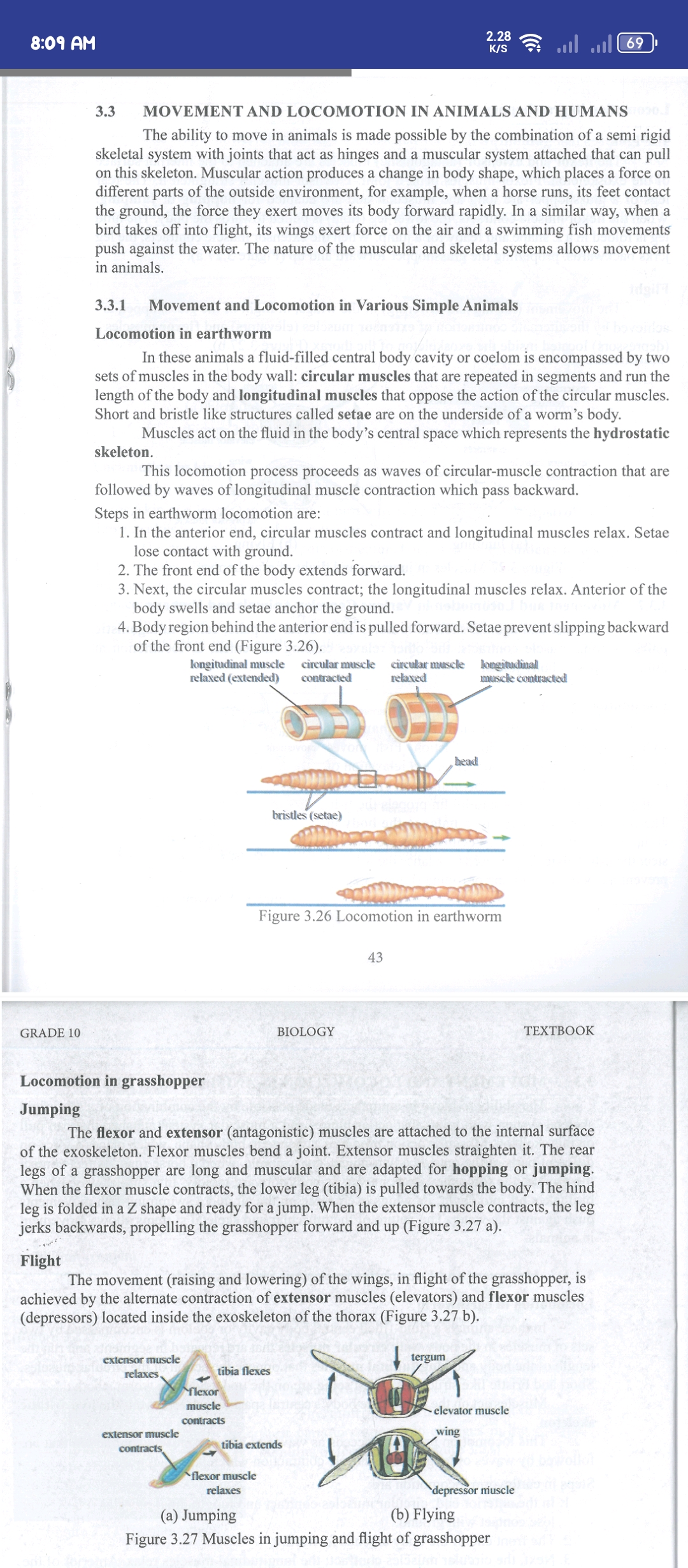
50. According to the text, what type of skeleton does an earthworm have, which consists of a fluid-filled central body cavity?
Explanation: The text states that in earthworms, 'Muscles act on the fluid in the body's central space which represents the hydrostatic skeleton.'
51. In earthworm locomotion, what is the effect of the circular muscles contracting while the longitudinal muscles relax in a segment?
Explanation: As described in steps 1 and 2 of earthworm locomotion, when circular muscles contract and longitudinal muscles relax, the front end of the body extends forward. The diagram (Figure 3.26) also illustrates that a segment with contracted circular muscles is elongated.
52. What is the primary function of the bristle-like structures called setae in an earthworm?
Explanation: The text explains that setae 'anchor the ground' and 'prevent slipping backward' during the wave of muscle contractions that produces movement.
53. For a grasshopper to prepare for a jump, its hind leg is folded. Which muscle action causes this?
Explanation: The text on jumping states: 'When the flexor muscle contracts, the lower leg (tibia) is pulled towards the body. The hind leg is folded in a Z shape and ready for a jump.' This is also shown in Figure 3.27a.
54. Which pair of muscles in a grasshopper works antagonistically to produce jumping movements?
Explanation: The text explicitly refers to 'The flexor and extensor (antagonistic) muscles' being responsible for bending and straightening the joint in a grasshopper's leg for jumping.
55. During the flight of a grasshopper, which muscles are responsible for raising the wings?
Explanation: The section on flight mentions that movement of the wings is achieved by the 'alternate contraction of extensor muscles (elevators) and flexor muscles (depressors)'. The elevators are responsible for raising the wings, as shown in Figure 3.27b.
56. What action propels a grasshopper forward and up into a jump?
Explanation: The text describes the jump: 'When the extensor muscle contracts, the leg jerks backwards, propelling the grasshopper forward and up.'
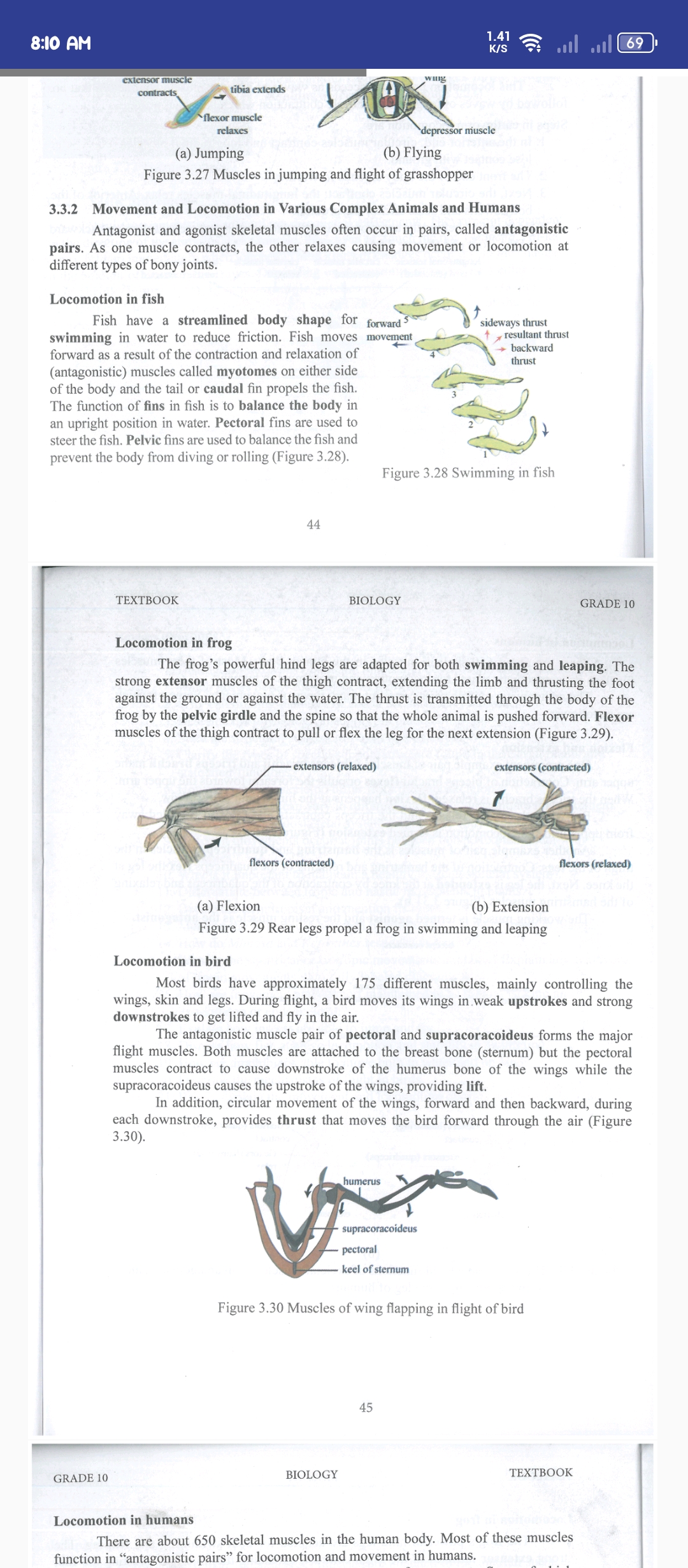
57. According to the text and Figure 3.27, what muscle action allows a grasshopper to jump?
Explanation: Figure 3.27 (a) shows that for a grasshopper to jump, the extensor muscle contracts, which causes the tibia to extend, while the antagonistic flexor muscle relaxes.
58. What is the primary function of the pectoral fins on a fish?
Explanation: The text under 'Locomotion in fish' explicitly states, 'Pectoral fins are used to steer the fish.'
59. Which muscle is responsible for the powerful downstroke of a bird's wings, which provides lift during flight?
Explanation: The text on 'Locomotion in bird' states that 'the pectoral muscles contract to cause downstroke of the humerus bone of the wings... providing lift.'
60. When a frog extends its hind legs to leap or swim, which muscles contract?
Explanation: As described in the section on frog locomotion and shown in Figure 3.29 (b), the strong extensor muscles of the thigh contract to extend the limb for leaping or swimming.
61. The text describes how muscles in different animals often work in 'antagonistic pairs'. What does this mean?
Explanation: The introductory paragraph under section 3.3.2 defines this principle: 'As one muscle contracts, the other relaxes causing movement or locomotion at different types of bony joints.'
62. What is the primary role of the myotomes in fish?
Explanation: The text states that a fish moves forward 'as a result of the contraction and relaxation of (antagonistic) muscles called myotomes on either side of the body'.
63. To which bone are the major flight muscles of a bird, the pectoral and supracoracoideus, attached?
Explanation: In the 'Locomotion in bird' section, the text clearly states, 'Both muscles are attached to the breast bone (sternum).'
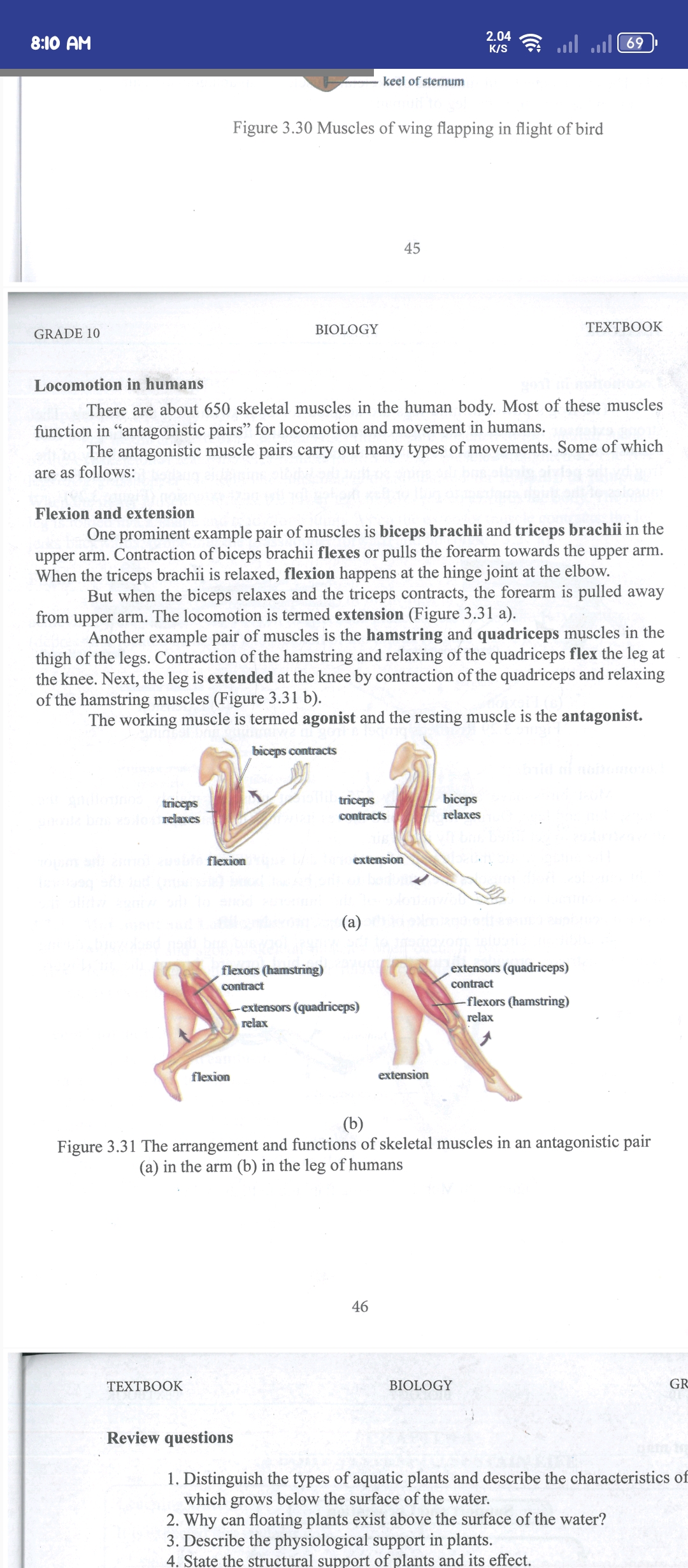
64. According to Figure 3.31(a), what happens to the biceps and triceps muscles during the extension of the arm?
Explanation: The diagram and text both indicate that for arm extension, the triceps brachii contracts to pull the forearm away from the upper arm, while the biceps brachii relaxes.
65. The text describes a working muscle as an 'agonist' and a resting muscle as an 'antagonist'. During the flexion of the leg at the knee, which muscle is the agonist?
Explanation: As stated in the text and shown in Figure 3.31(b), flexion of the leg at the knee is caused by the contraction of the hamstring (flexor), making it the agonist in this movement.
66. What is the primary function of the quadriceps muscle as illustrated in Figure 3.31(b)?
Explanation: The diagram labels the quadriceps as 'extensors' and shows them contracting to straighten or extend the leg.
67. What general term does the textbook use to describe pairs of muscles, like the biceps and triceps, that work in opposition to each other for movement?
Explanation: The text explicitly states, 'Most of these muscles function in “antagonistic pairs” for locomotion and movement in humans.'
68. What movement is produced when the biceps brachii contracts and the triceps brachii relaxes?
Explanation: The text describes that the 'Contraction of biceps brachii flexes or pulls the forearm towards the upper arm.' This movement is called flexion.
69. Which of the following pairs of muscles are presented as an example of an antagonistic pair in the thigh?
Explanation: The text provides a second example of an antagonistic pair: '...the hamstring and quadriceps muscles in the thigh of the legs.'
70. Based on Figure 3.31(b), what is the state of the hamstring and quadriceps muscles during the extension of the leg?
Explanation: The diagram for leg extension clearly shows the extensors (quadriceps) contracting and the flexors (hamstring) relaxing to straighten the leg.