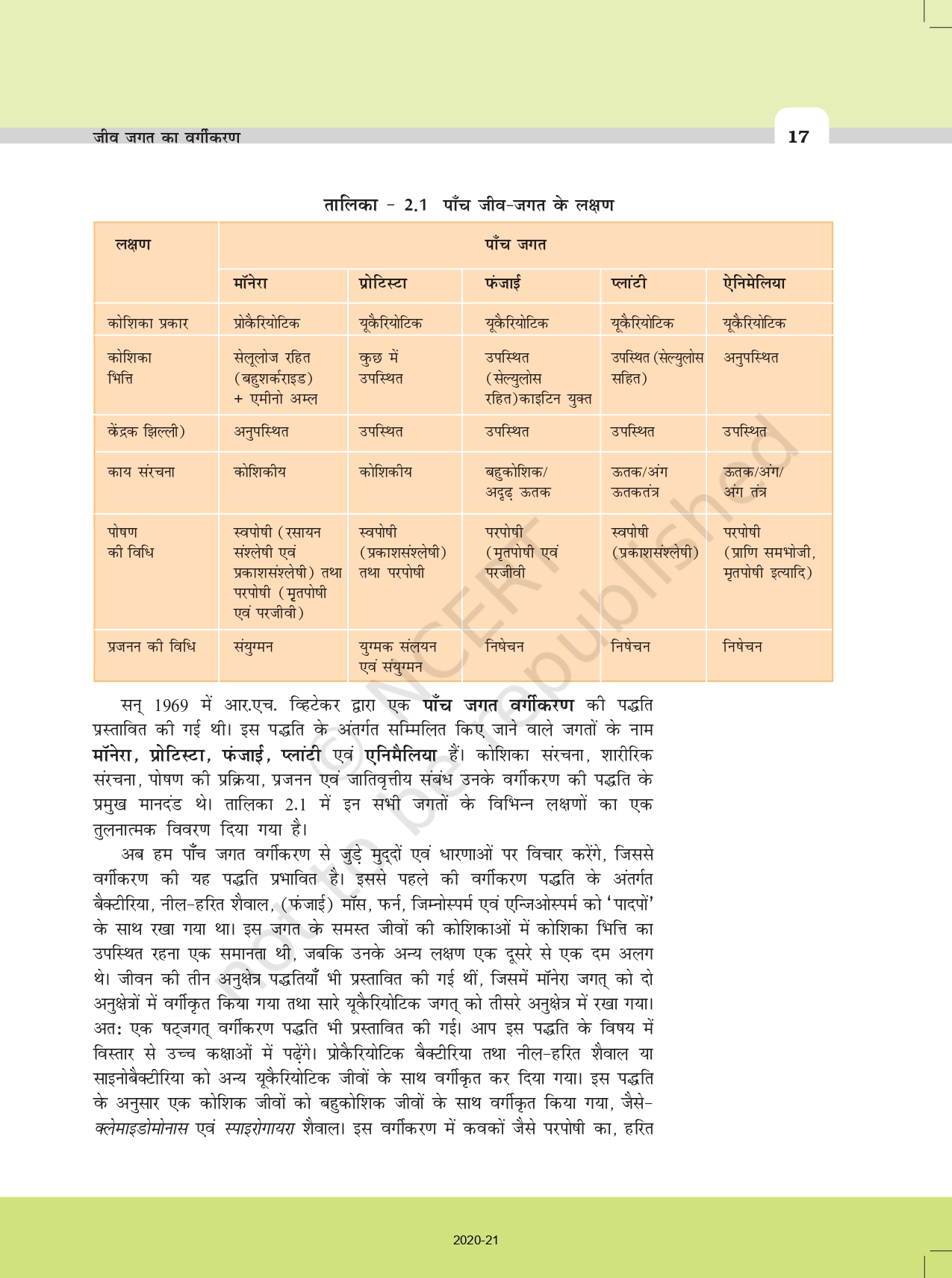
जीवों के पाँच जगतों की अपनी समझ का परीक्षण करें। यह प्रश्नोत्तरी मॉनेरा, प्रोटिस्टा, फंजाई, प्लांटी और ऐनिमेलिया में जीवों को वर्गीकृत करने के लिए उपयोग की जाने वाली प्रमुख विशेषताओं पर केंद्रित है।
Pages: 1Questions per page: 4
Rate this quiz
☆☆☆☆☆
Avg: 0.00 ( 0 )
Score: 0Page 1 / 1
1. According to the table, which kingdom is characterized by being prokaryotic and lacking a nuclear membrane?
Explanation: The table clearly shows that for the Monera kingdom, the 'कोशिका प्रकार' (Cell type) is 'प्रोकेरियोटिक' (Prokaryotic) and the 'केंद्रक झिल्ली' (Nuclear membrane) is 'अनुपस्थित' (Absent). All other kingdoms are eukaryotic and have a nuclear membrane.
2. What is the key difference in the cell wall composition between the Fungi and Plantae kingdoms as shown in the table?
Explanation: In the 'कोशिका भित्ति' (Cell wall) row, it is stated that Fungi have a cell wall that is 'उपस्थित (सेल्लुलोस रहित) काइटिन युक्त' (Present (without cellulose), with chitin), whereas Plantae have a cell wall that is 'उपस्थित (सेल्लुलोस सहित)' (Present (with cellulose)).
3. Based on the table, which of the five kingdoms completely lacks a cell wall?
Explanation: The row for 'कोशिका भित्ति' (Cell wall) indicates 'अनुपस्थित' (Absent) for the Animalia kingdom. All other kingdoms have members with a cell wall.
4. According to the text accompanying the table, who proposed the five-kingdom classification system and in what year?
Explanation: The first sentence of the text below the table states: 'सन् 1969 में आर.एच. व्हिटेकर द्वारा एक पाँच जगत वर्गीकरण की पद्धति प्रस्तावित की गई थी।' This translates to 'In the year 1969, a five-kingdom classification system was proposed by R.H. Whittaker.'