This quiz covers the fundamental particles of an atom and the discovery of the electron through J.J. Thomson's cathode ray tube experiment.
Pages: 5Questions per page: 10
Rate this quiz
☆☆☆☆☆
Avg: 0.00 ( 0 )
Score: 0Page 1 / 5
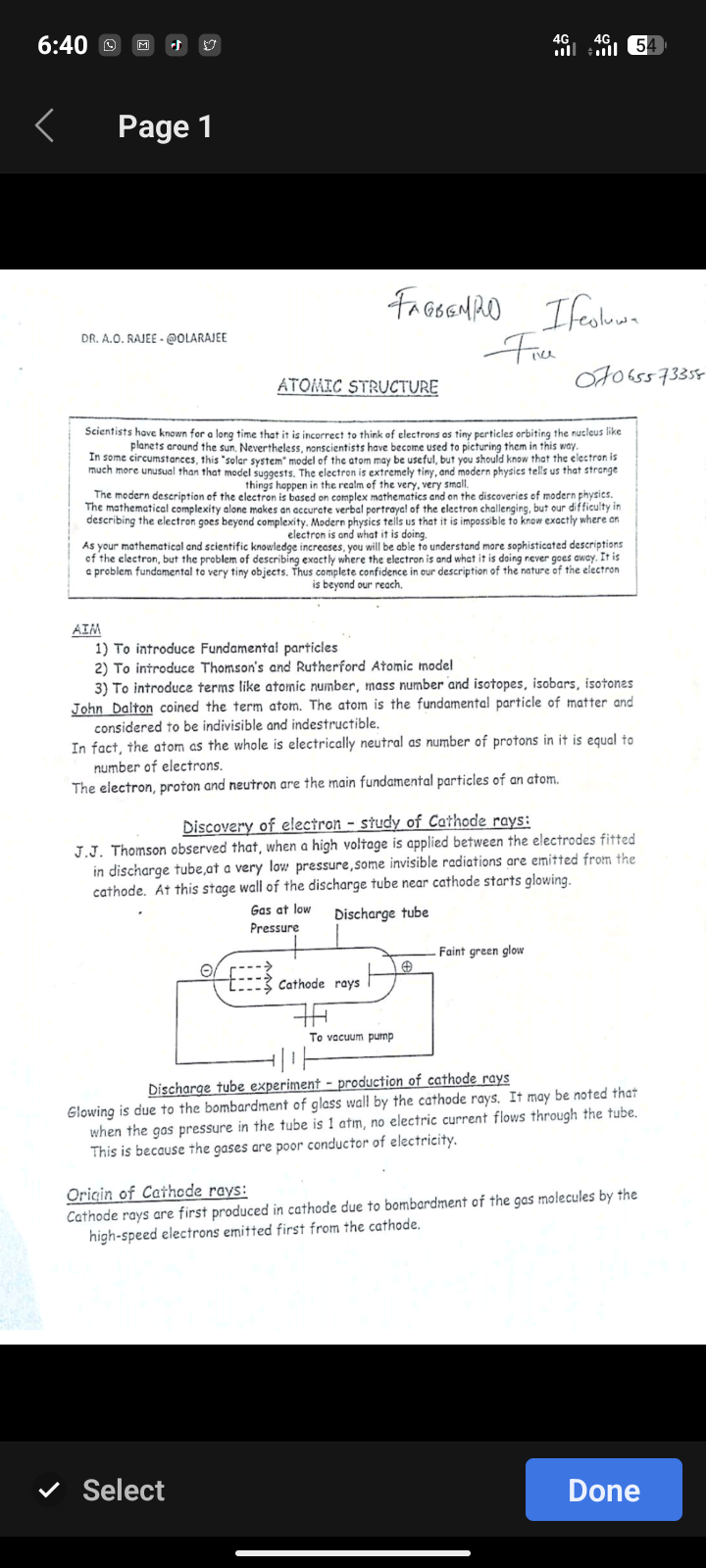
1. According to the text, what are the necessary conditions for producing cathode rays in a discharge tube?
Explanation: The text states, 'J.J. Thomson observed that, when a high voltage is applied between the electrodes fitted in discharge tube, at a very low pressure, some invisible radiations are emitted from the cathode.'
2. Who does the document credit with coining the term 'atom'?
Explanation: The text explicitly mentions, 'John Dalton coined the term atom.'
3. In the discharge tube experiment, what causes the faint green glow on the glass wall?
Explanation: The text explains, 'Glowing is due to the bombardment of glass wall by the cathode rays.'
4. Why is an atom considered electrically neutral as a whole?
Explanation: The document states, 'In fact, the atom as the whole is electrically neutral as number of protons in it is equal to number of electrons.'
5. Based on the text, why does no electric current flow through the tube when the gas pressure is at 1 atm?
Explanation: The text notes that at 1 atm, no current flows, and 'This is because the gases are poor conductor of electricity.'
6. In the diagram of the discharge tube, from which electrode do the cathode rays originate?
Explanation: The diagram shows the rays, labeled 'Cathode rays', originating from the electrode marked with a negative sign (—), which is the cathode.
7. What is the modern description of an electron's behavior, as contrasted with the 'solar system' model?
Explanation: The introductory paragraph states the modern description is based on 'complex mathematics' and that it is 'impossible to know exactly where an electron is and what it is doing.'
8. What are cathode rays, according to the 'Origin of Cathode rays' section?
Explanation: The text clarifies, 'Cathode rays are electrons emitted first from the cathode.'
9. Which of the following topics is NOT listed under the 'AIM' section of the document?
Explanation: The 'AIM' section lists introducing fundamental particles, Thomson's/Rutherford's models, and terms like atomic number, but does not mention explaining quantum mechanics in detail.
10. According to Dalton's original concept described in the text, the atom was considered to be:
Explanation: The text says, 'The atom is the fundamental particle of matter and considered to be indivisible and indestructible.'
11. According to the text, which of the following is NOT a property of cathode rays?
Explanation: Point x under 'Properties of Cathode rays' explicitly states: 'The nature of the cathode rays does not depend upon the nature of the gas, taken in the discharge tube and the nature of cathode material.'
12. Who discovered the presence of positive rays (also known as anode rays)?
Explanation: The text states in the section 'Discovery of proton - study of Anode rays': 'Goldstein discovered the presence of positive rays.'
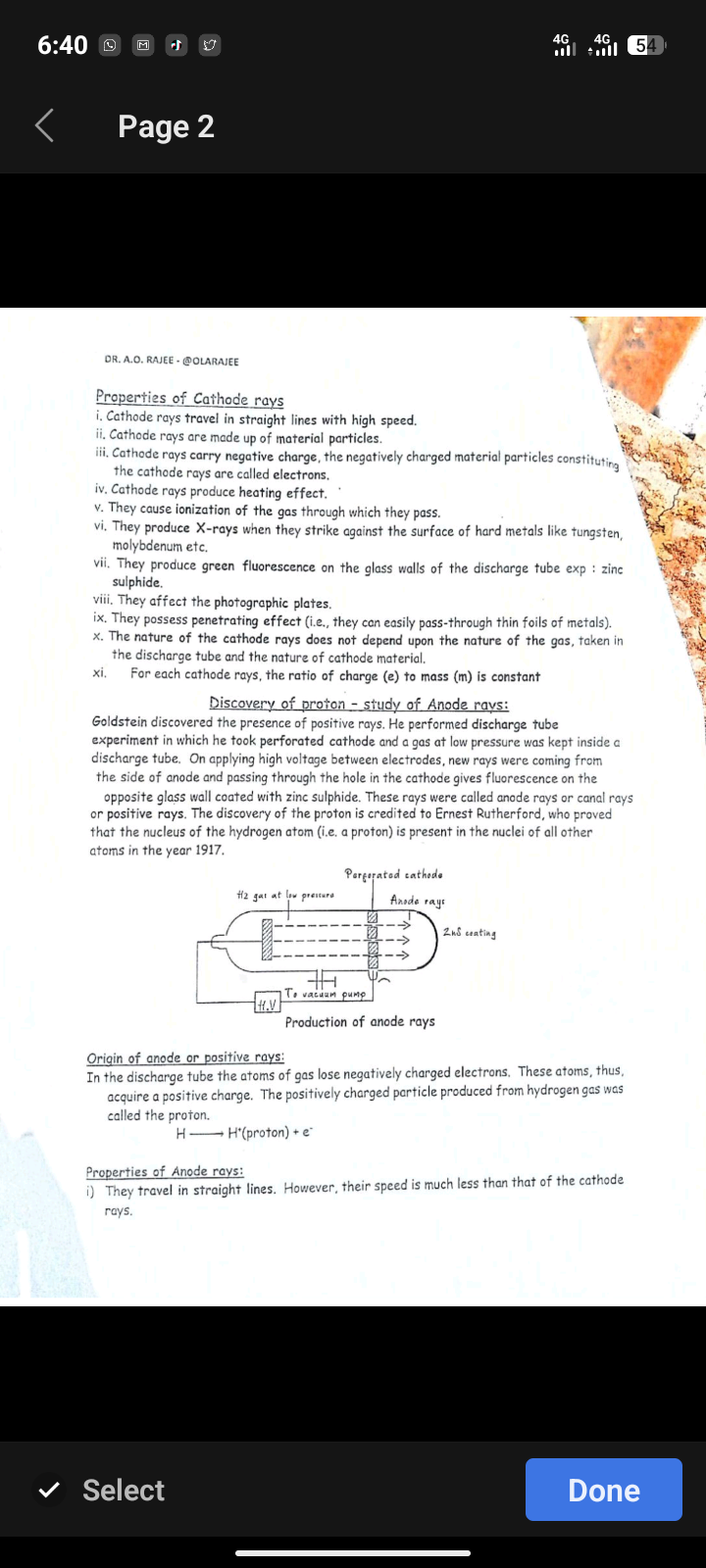
13. What modification to the cathode was essential in the experiment to observe anode rays?
Explanation: The text describes the experiment: 'He performed experiment in which he took a perforated cathode...' The diagram also labels the 'Perforated cathode'.
14. How are anode rays (positive rays) formed in the discharge tube?
Explanation: Under 'Origin of anode or positive rays,' it says, 'In the discharge tube the atoms of gas lose negatively charged electrons. These atoms, thus, acquire a positive charge.'
15. How does the speed of anode rays compare to that of cathode rays?
Explanation: The first point under 'Properties of Anode rays' states: 'However, their speed is much less than that of the cathode rays.'
16. The negatively charged material particles that make up cathode rays are called:
Explanation: Point iii under 'Properties of Cathode rays' states that 'the negatively charged material particles constituting the cathode rays are called electrons.'
17. Who is credited with the discovery of the proton by proving it exists in the nuclei of all atoms?
Explanation: The text states, 'The discovery of the proton is credited to Ernest Rutherford, who proved that the nucleus of the hydrogen atom (i.e. a proton) is present in the nuclei of all other atoms in the year 1917.'
18. What happens when cathode rays strike the surface of hard metals like tungsten?
Explanation: According to property vi of cathode rays, 'They produce X-rays when they strike against the surface of hard metals like tungsten, molybdenum etc.'
19. In the experiment for producing anode rays, where is the fluorescence observed?
Explanation: The text describes that the rays passing 'through the hole in the cathode gives fluorescence on the opposite glass wall coated with zinc sulphide.' This wall is behind the cathode.
20. What is true about the charge-to-mass (e/m) ratio for cathode rays?
Explanation: Property xi for cathode rays states: 'For each cathode rays, the ratio of charge (e) to mass (m) is constant.'
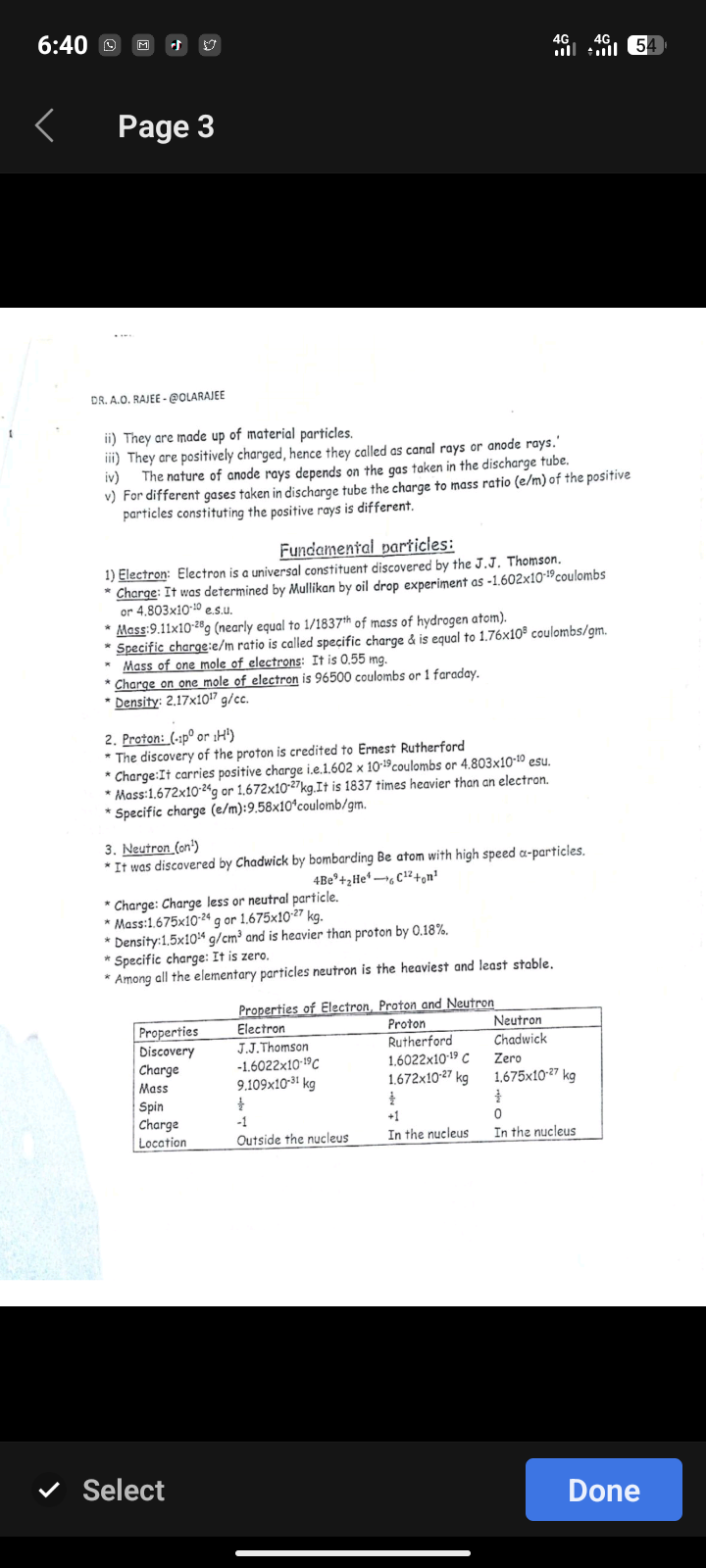
21. According to the text, who discovered the electron?
Explanation: The text under 'Fundamental particles' states that the electron was 'discovered by the J.J. Thomson'. The summary table also lists J.J. Thomson as the discoverer of the electron.
22. Which experiment was used to determine the charge of an electron?
Explanation: Under section 1) Electron, the first bullet point states, 'Charge: It was determined by Millikan by oil drop experiment'.
23. What is the charge of a proton as listed in the summary table?
Explanation: The table titled 'Properties of Electron, Proton and Neutron' lists the charge of a proton as 1.6022x10⁻¹⁹ C.
24. The document states that the neutron is heavier than the proton by what percentage?
Explanation: In section 3) Neutron, the text specifies that the neutron's mass 'is heavier than proton by 0.18%'.
25. Who is credited with the discovery of the neutron?
Explanation: Both the main text for section 3) Neutron and the summary table state that the neutron was discovered by Chadwick.
26. Based on the table, where are protons and neutrons located?
Explanation: The last row of the summary table, labeled 'Location', indicates that both protons and neutrons are found 'In the nucleus'.
27. According to the text, the nature of anode rays depends on what factor?
Explanation: Point (iv) at the top of the page states, 'The nature of anode rays depends on the gas taken in the discharge tube.'
28. Which particle is described as the 'heaviest and least stable' among the elementary particles?
Explanation: The last bullet point under section 3) Neutron states, 'Among all the elementary particles neutron is the heaviest and least stable.'
29. What is the value given for the charge on one mole of electrons, also known as 1 faraday?
Explanation: In the section about the electron, a bullet point reads: 'Charge on one mole of electron is 96500 coulombs or 1 faraday.'
30. What is the mass of an electron as listed in the summary table?
Explanation: The summary table under the 'Electron' column and in the 'Mass' row shows the value 9.109x10⁻³¹ kg.
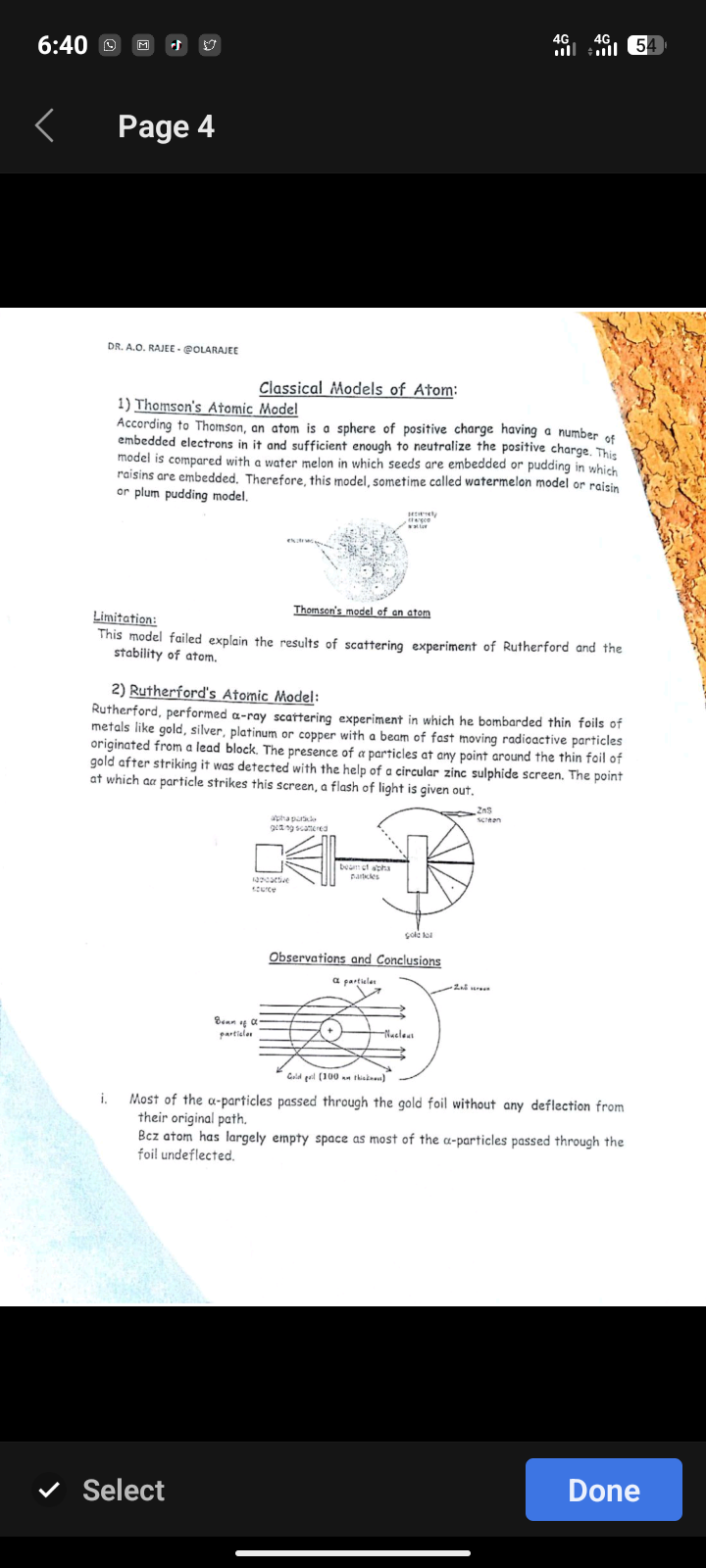
31. According to the text, what is Thomson's atomic model also known as?
Explanation: The text states, 'This model is compared with a water melon in which seeds are embedded or pudding in which raisins are embedded. Therefore, this model, sometime called watermelon model or raisin or plum pudding model.'
32. What was a major limitation of Thomson's atomic model as mentioned in the text?
Explanation: The text explicitly states under 'Limitation', 'This model failed explain the results of scattering experiment of Rutherford and the stability of atom.'
33. In Rutherford's alpha-ray scattering experiment, what was the purpose of the zinc sulphide (ZnS) screen?
Explanation: The text describes that the presence of alpha particles was 'detected with the help of a circular zinc sulphide screen' and that 'at which an α particle strikes this screen, a flash of light is given out.'
34. What material was bombarded by alpha particles in Rutherford's experiment, as shown in the diagram?
Explanation: The text mentions that Rutherford bombarded thin foils of metals like gold, and the diagrams are specifically labeled 'Gold foil'.
35. What was the most common observation in Rutherford's scattering experiment?
Explanation: Point 'i' under 'Observations and Conclusions' states, 'Most of the α-particles passed through the gold foil without any deflection from their original path.'
36. What major conclusion was drawn from the observation that most alpha particles passed straight through the gold foil?
Explanation: The text concludes from this observation that 'The atom has largely empty space as most of the α-particles passed through the foil undeflected.'
37. In Thomson's model, how is the electrical neutrality of the atom explained?
Explanation: The text describes Thomson's model as having 'a number of embedded electrons in it and sufficient enough to neutralize the positive charge.'
38. What was the source of the fast-moving particles used in Rutherford's experiment?
Explanation: The text states that Rutherford used 'a beam of fast moving radioactive particles originated from a lead block.' The diagram also shows a 'Radioactive source'.
39. Which of these is NOT a component of the experimental setup for Rutherford's scattering experiment as depicted in the diagram?
Explanation: The diagram shows a radioactive source, a beam of alpha particles, a gold foil, and a circular ZnS screen, but there is no mention or depiction of a magnetic field generator.
40. Based on the text, Rutherford's model was developed as a result of what?
Explanation: The section on Rutherford's Atomic Model begins by stating, 'Rutherford performed α-ray scattering experiment in which he bombarded thin foils of metals...'
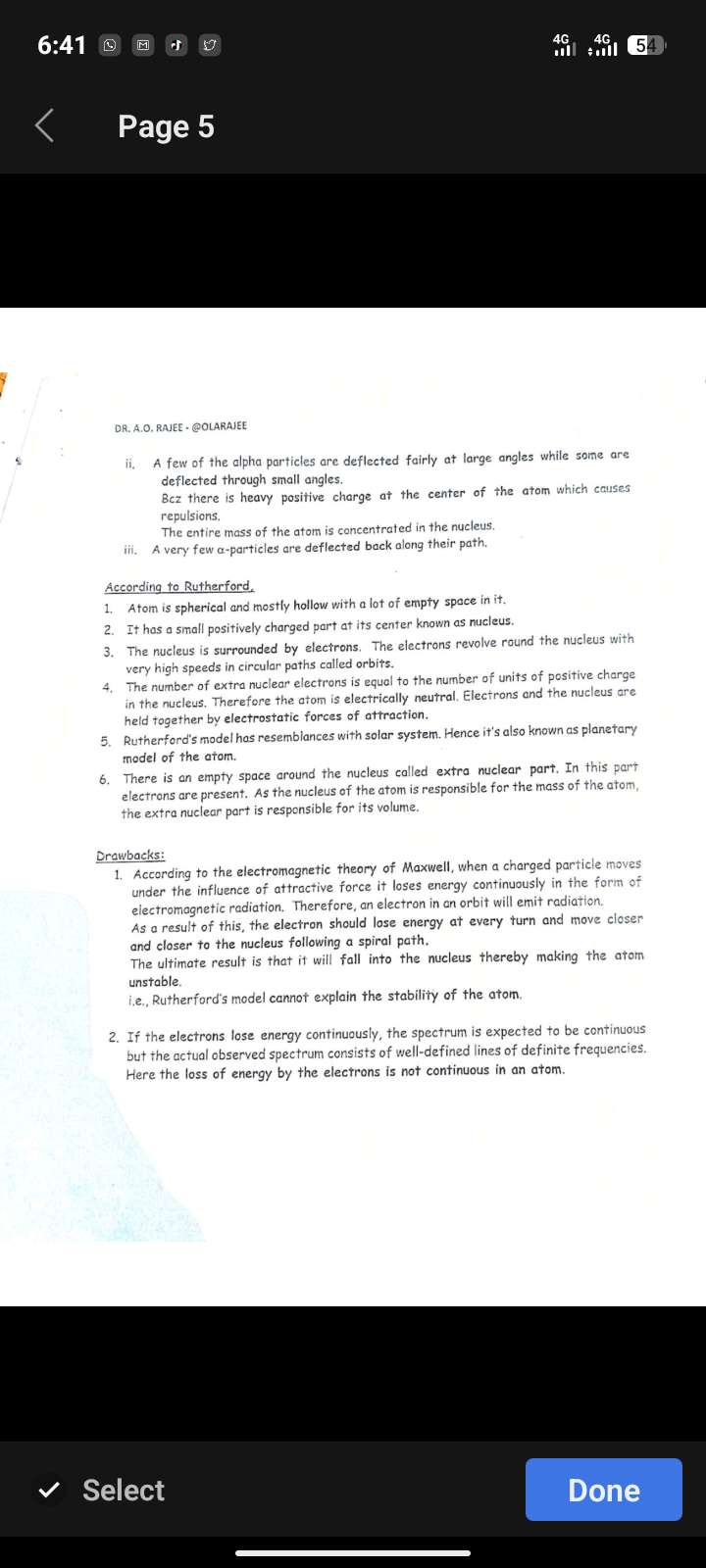
41. According to Rutherford's model, where is most of the mass of an atom concentrated?
Explanation: The text states, 'The entire mass of the atom is concentrated in the nucleus.' and 'As the nucleus of the atom is responsible for the mass...'
42. Why is Rutherford's atomic model also known as the 'planetary model'?
Explanation: Point 5 in the text explicitly says, 'Rutherford's model has resemblances with solar system. Hence it's also known as planetary model of the atom.'
43. What is a major drawback of Rutherford's model according to Maxwell's electromagnetic theory?
Explanation: The 'Drawbacks' section explains that an orbiting electron should continuously lose energy, '...and closer to the nucleus following a spiral path. The ultimate result is that it will fall into the nucleus thereby making the atom unstable.'
44. How does Rutherford's model account for the electrical neutrality of an atom?
Explanation: Point 4 states, 'The number of extra nuclear electrons is equal to the number of units of positive charge in the nucleus. Therefore the atom is electrically neutral.'
45. Rutherford's model failed to explain the nature of atomic spectra. What kind of spectrum did the model predict versus what is actually observed?
Explanation: The second drawback states, 'If the electrons lose energy continuously, the spectrum is expected to be continuous but the actual observed spectrum consists of well-defined lines of definite frequencies.'
46. Based on the text, what part of the atom is responsible for its volume?
Explanation: The last sentence of point 6 says, '...the extra nuclear part is responsible for its volume.'
47. What force holds the electrons in their orbits around the nucleus in Rutherford's model?
Explanation: At the end of point 4, the text mentions, 'Electrons and the nucleus are held together by electrostatic forces of attraction.'
48. What inference was made from the observation that a few alpha particles were deflected at large angles?
Explanation: The text explains the deflection of alpha particles with the line: 'Bcz there is heavy positive charge at the center of the atom which causes repulsions.'
49. According to the principles of Rutherford's model described in the text, what is the fundamental structure of an atom?
Explanation: Point 1 under 'According to Rutherford' states, 'Atom is spherical and mostly hollow with a lot of empty space in it,' and point 2 mentions a 'small positively charged part at its center known as nucleus.'
50. What is the ultimate consequence for an electron in orbit according to the drawbacks of Rutherford's model?
Explanation: The first drawback states, 'The ultimate result is that it will fall into the nucleus thereby making the atom unstable.'