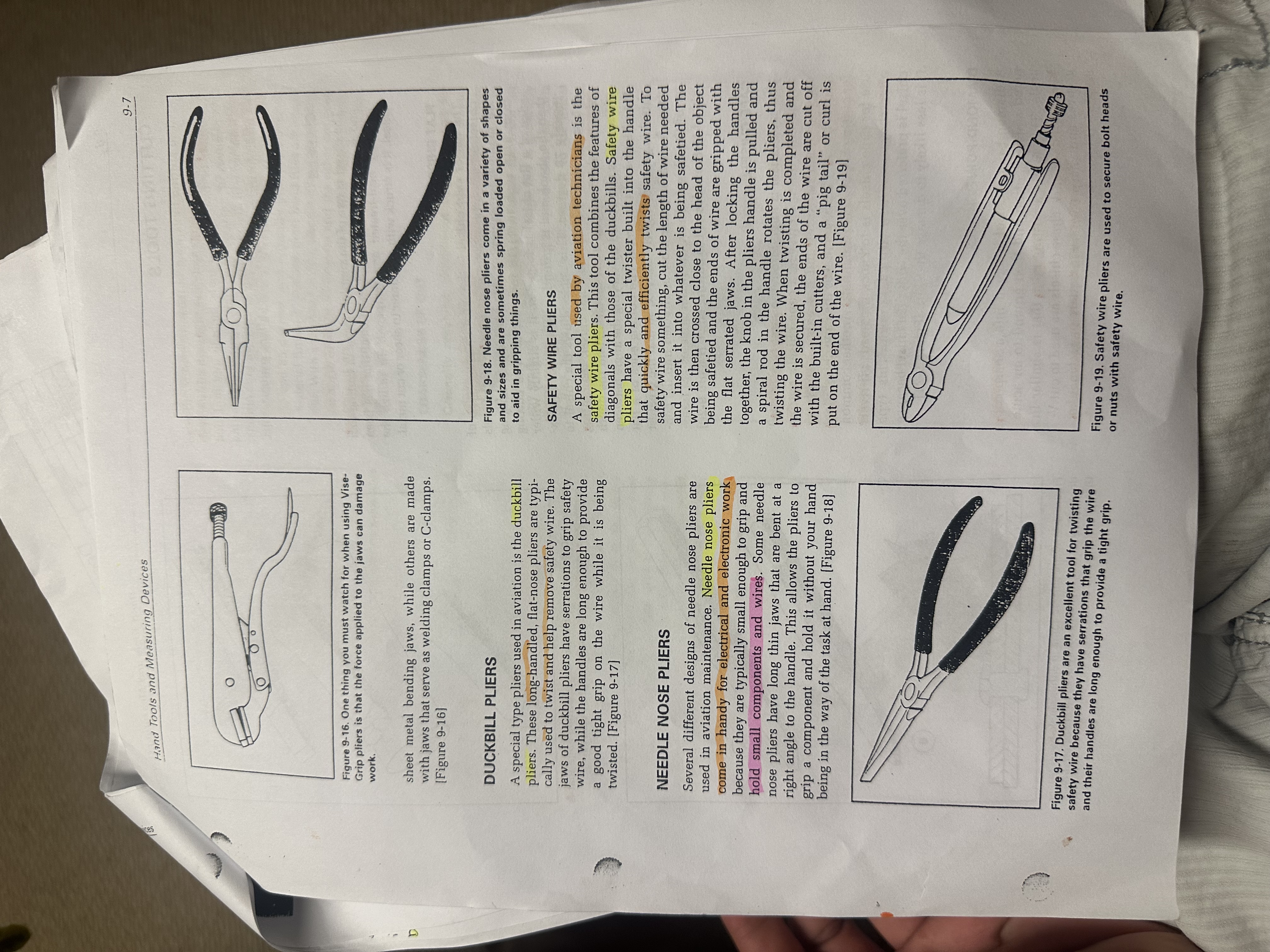
Learn to identify and understand the uses for different types of pliers in aviation, including duckbill, needle nose, and safety wire pliers.
Pages: 2Questions per page: 10
Rate this quiz
☆☆☆☆☆
Avg: 0.00 ( 0 )
Score: 0Page 1 / 2
1. According to the text, what is a primary use for duckbill pliers in aviation?
Explanation: The text under 'DUCKBILL PLIERS' states, 'These long-handled, flat-nose pliers are typically used to twist and help remove safety wire.'
2. Which type of pliers is described as being particularly handy for electrical and electronic work?
Explanation: The section on 'NEEDLE NOSE PLIERS' says they 'come in handy for electrical and electronic work because they are typically small enough to grip and hold small components and wires.'
3. What unique feature of safety wire pliers allows them to 'quickly and efficiently' twist safety wire?
Explanation: The text for 'SAFETY WIRE PLIERS' mentions they 'have a special twister built into the handle that quickly and efficiently twists safety wire.'
4. Which tool is specifically identified as a combination of the features of diagonals (cutters) and duckbill pliers?
Explanation: The first sentence of the 'SAFETY WIRE PLIERS' section states, 'This tool combines the features of diagonals with those of the duckbills.'
5. What feature of duckbill pliers' jaws is mentioned as helping to grip safety wire?
Explanation: The text describes duckbill pliers by saying, 'The jaws of duckbill pliers have serrations to grip safety wire.'
6. An aviation technician needs to secure a bolt head using safety wire, as shown in Figure 9-19. Which tool is designed for this task?
Explanation: The caption for Figure 9-19 explicitly states, 'Safety wire pliers are used to secure bolt heads or nuts with safety wire.'
7. What is a characteristic of needle nose pliers that makes them suitable for holding components without your hand getting in the way?
Explanation: The text notes that needle nose pliers have 'long thin jaws' which 'allows the pliers to grip a component and hold it without your hand being in the way of the task at hand.'
8. What is a potential risk to watch for when using Vise-Grip pliers, as mentioned in the caption for Figure 9-16?
Explanation: The caption for Figure 9-16 warns, 'One thing you must watch for when using Vise-Grip pliers is that the force applied to the jaws can damage work.'
9. After the wire is twisted and secured with safety wire pliers, what is the final step described in the text?
Explanation: The description for using safety wire pliers concludes with: 'the ends of the wire are cut off with the built-in cutters, and a “pig tail” or curl is put on the end of the wire.'
10. Which of these pliers are NOT specifically mentioned as being used in aviation maintenance in the provided text?
Explanation: The text explicitly states that duckbill pliers, needle nose pliers, and safety wire pliers are used in aviation. Vise-Grip pliers are described generally without a specific mention of aviation use.
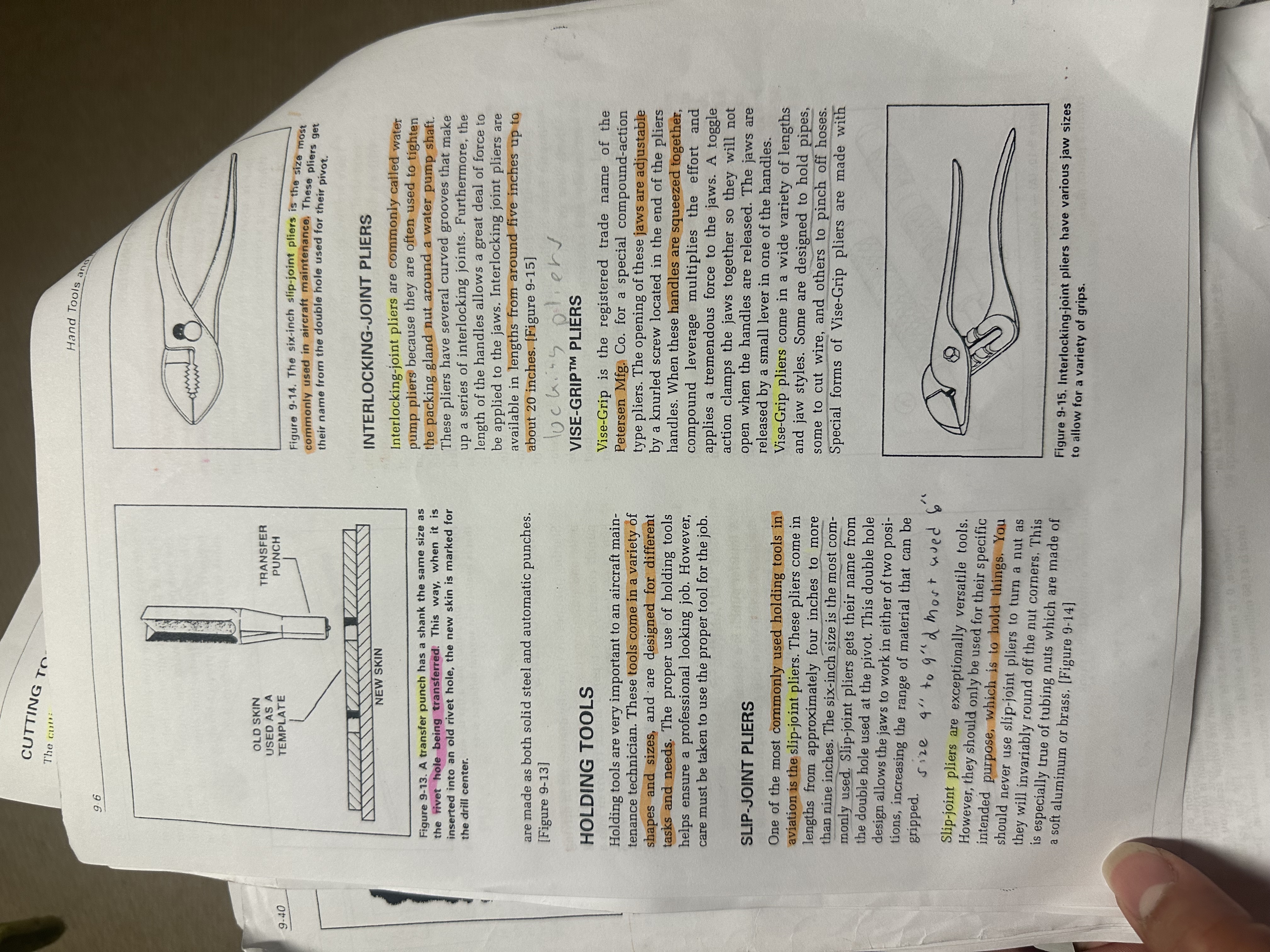
11. According to Figure 9-13, what is the purpose of a transfer punch?
Explanation: The caption for Figure 9-13 states: 'A transfer punch has a shank the same size as the rivet hole being transferred. This way, when it is inserted into an old rivet hole, the new skin is marked for the drill center.'
12. What is the most commonly used size of slip-joint pliers in aircraft maintenance?
Explanation: The text under 'SLIP-JOINT PLIERS' states, 'The six-inch size is the most commonly used.'
13. Interlocking-joint pliers are commonly called water pump pliers for what reason?
Explanation: The text explains, 'Interlocking-joint pliers are commonly called water pump pliers because they are often used to tighten the packing gland nut around a water pump shaft.'
14. What is the specific intended purpose of slip-joint pliers, as stated in the text?
Explanation: The text explicitly states that their specific intended purpose 'is to hold things' and warns, 'You should never use slip-joint pliers to turn a nut as they will invariably round off the nut corners.'
15. How is the jaw opening of Vise-Grip pliers adjusted?
Explanation: The section on Vise-Grip pliers mentions, 'The opening of these jaws are adjustable by a knurled screw located in the end of the pliers handles.'
16. What is the typical range of available lengths for interlocking-joint pliers?
Explanation: The text states, 'Interlocking joint pliers are available in lengths from around five inches up to about 20 inches.'
17. What mechanism allows Vise-Grip pliers to apply tremendous force and lock in place?
Explanation: The description of Vise-Grip pliers says, 'When these handles are squeezed together, compound leverage multiplies the effort and applies a tremendous force to the jaws. A toggle action clamps the jaws together so they will not open when the handles are released.'
18. From what feature do slip-joint pliers get their name?
Explanation: The text explains, 'Slip-joint pliers get their name from the double hole used at the pivot. This double hole design allows the jaws to work in either of two positions...'
19. According to the text, what is a key benefit of the proper use of holding tools?
Explanation: Under the 'HOLDING TOOLS' section, the text states, 'The proper use of holding tools helps ensure a professional looking job.'
20. In addition to holding pipes, what other specific tasks are some Vise-Grip pliers designed for?
Explanation: The text mentions, 'Some are designed to hold pipes, some to cut wire, and others to pinch off hoses.'