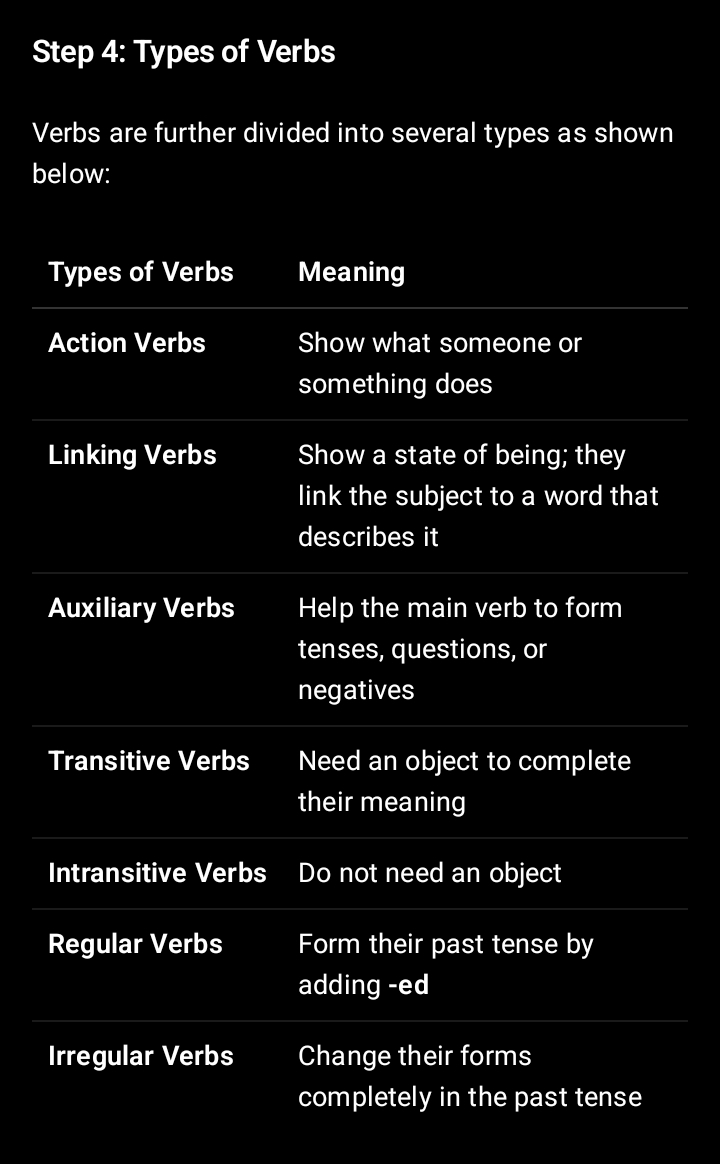
Test your knowledge of English grammar by matching different types of verbs to their correct definitions. See how well you can distinguish between action, linking, auxiliary verbs, and more.
Pages: 2Questions per page: 2
Rate this quiz
☆☆☆☆☆
Avg: 0.00 ( 0 )
Score: 0Page 1 / 2
1. According to the table, what is the key difference between a transitive verb and an intransitive verb?
Explanation: The table states that Transitive Verbs 'Need an object to complete their meaning', whereas Intransitive Verbs 'Do not need an object'.
2. Based on the image, which type of verb is defined as helping the main verb to form tenses, questions, or negatives?
Explanation: The 'Meaning' column for 'Auxiliary Verbs' explicitly states that they 'Help the main verb to form tenses, questions, or negatives'.
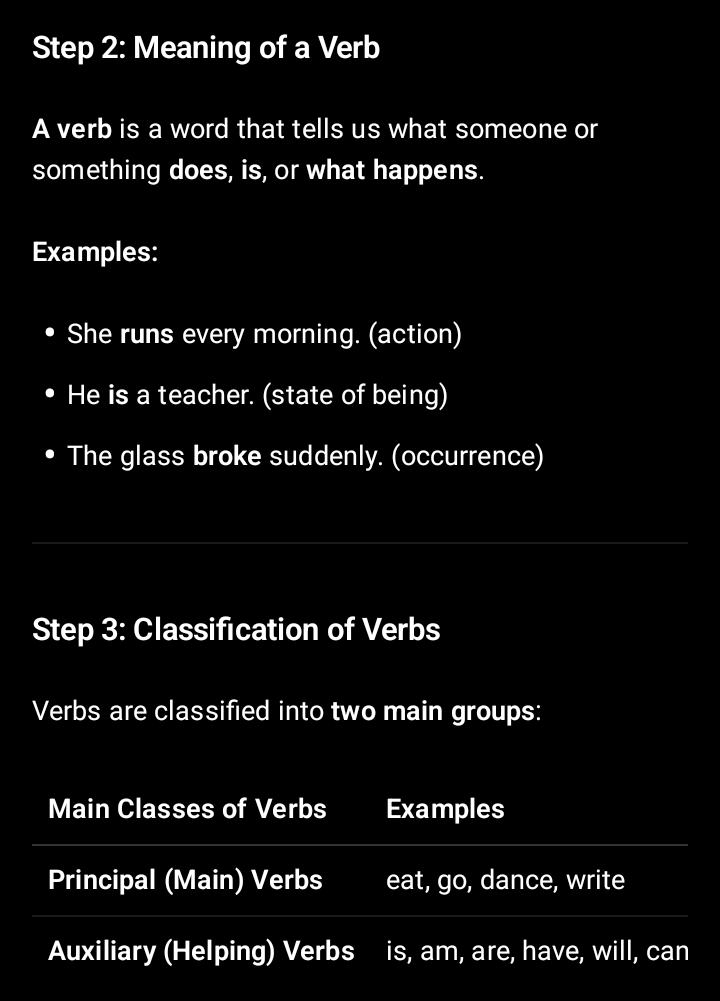
3. According to the text, a verb is a word that describes an action, a state of being, or what else?
Explanation: The text defines a verb as a word that tells us what someone or something 'does' (action), 'is' (state of being), or 'what happens' (occurrence). The example given for an occurrence is 'The glass broke suddenly.'
4. Based on the classification provided in the image, which of the following is an example of an Auxiliary (Helping) Verb?
Explanation: The table under 'Step 3: Classification of Verbs' lists 'is, am, are, have, will, can' as examples of Auxiliary (Helping) Verbs. The other options are listed as Principal (Main) Verbs.