Test your knowledge of key physics concepts like density, mass, and volume. This quiz is based on a lab experiment to determine why objects float or sink.
Pages: 3Questions per page: 5
Rate this quiz
☆☆☆☆☆
Avg: 0.00 ( 0 )
Score: 0Page 1 / 3
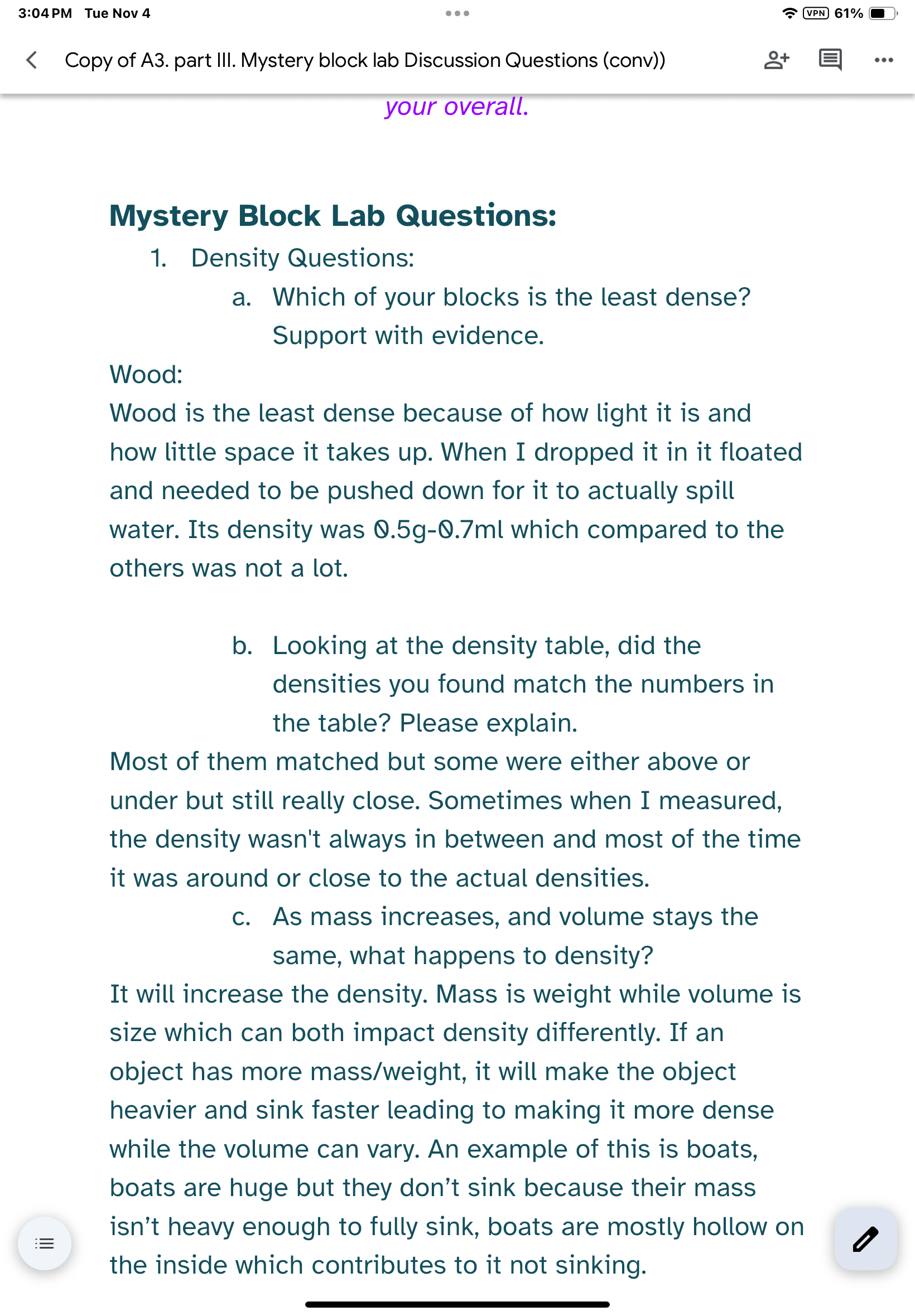
1. According to the lab report, which observation was provided as evidence that wood was the least dense block?
Explanation: The text states, 'When I dropped it in it floated and needed to be pushed down for it to actually spill water,' which is a key piece of evidence for its low density.
2. How did the student's measured densities compare to the values in the provided density table?
Explanation: The student wrote, 'Most of them matched but some were either above or under but still really close,' indicating that their experimental results were similar but not identical to the reference values.
3. Based on the answer to question 1c, what happens to an object's density if its mass increases while its volume remains constant?
Explanation: The first sentence of the answer to question 1c is 'It will increase the density.' This is consistent with the formula Density = Mass / Volume, where increasing the mass while keeping the volume constant results in a higher density.
4. In the explanation for question 1c, why is a boat mentioned as an example?
Explanation: The text explains that boats are large but don't sink because they are 'mostly hollow on the inside.' This example demonstrates that the average density of the entire object (material plus air-filled space) is what matters for floating.
5. The student reports the density of wood was '0.5g-0.7ml'. Although the unit is written incorrectly, what does this value most likely represent?
Explanation: In the context of a density lab, a value like this, despite the typo in the unit (ml instead of g/ml), is intended to represent the measured density of the object, likely expressed as a range due to measurement uncertainty.
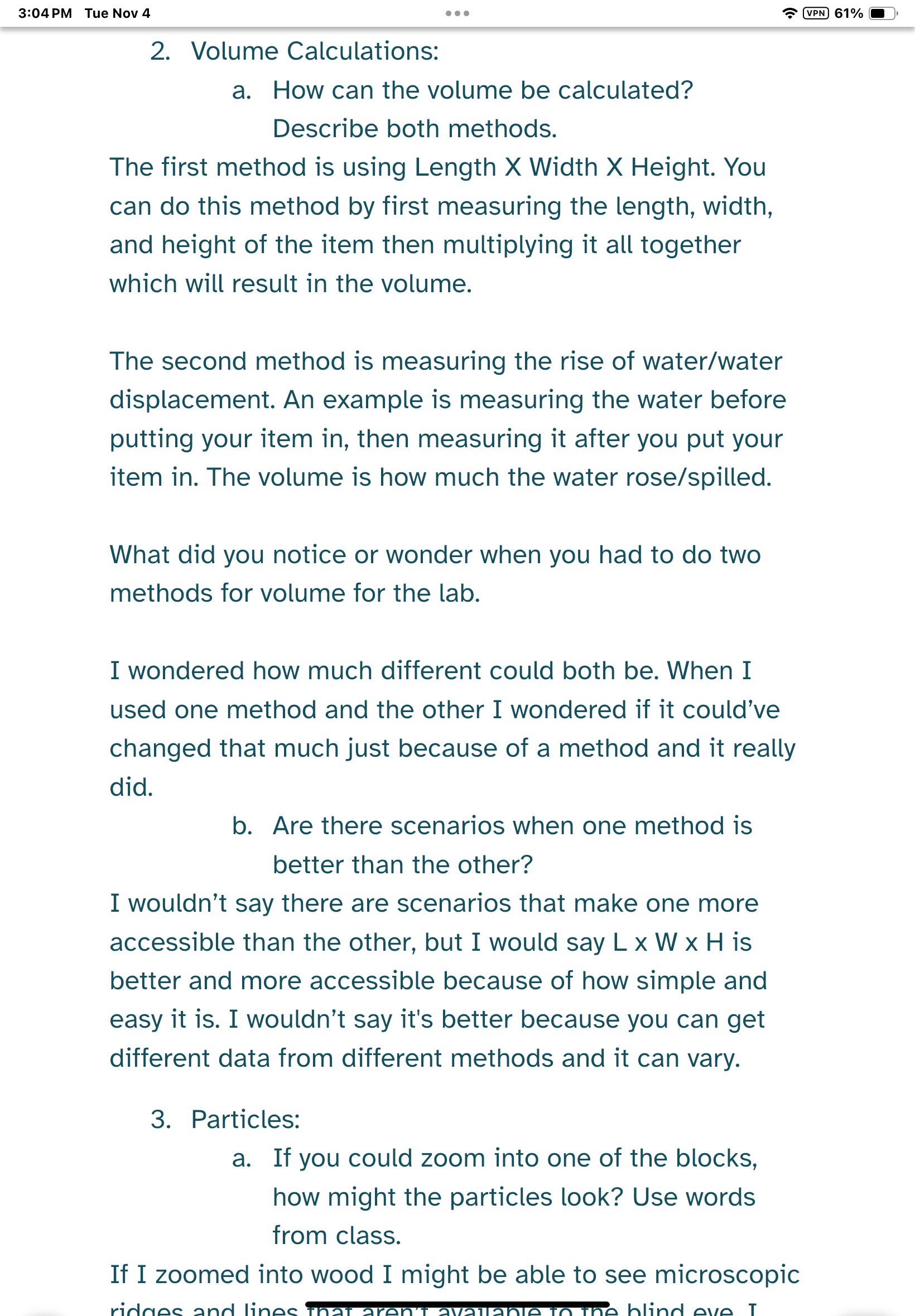
6. According to the text, what are the two methods described for calculating volume?
Explanation: The text explicitly states: 'The first method is using Length X Width X Height... The second method is measuring the rise of water/water displacement.'
7. How does the water displacement method work, as described in the passage?
Explanation: The text explains this method as: 'measuring the water before putting your item in, then measuring it after you put your item in. The volume is how much the water rose/spilled.'
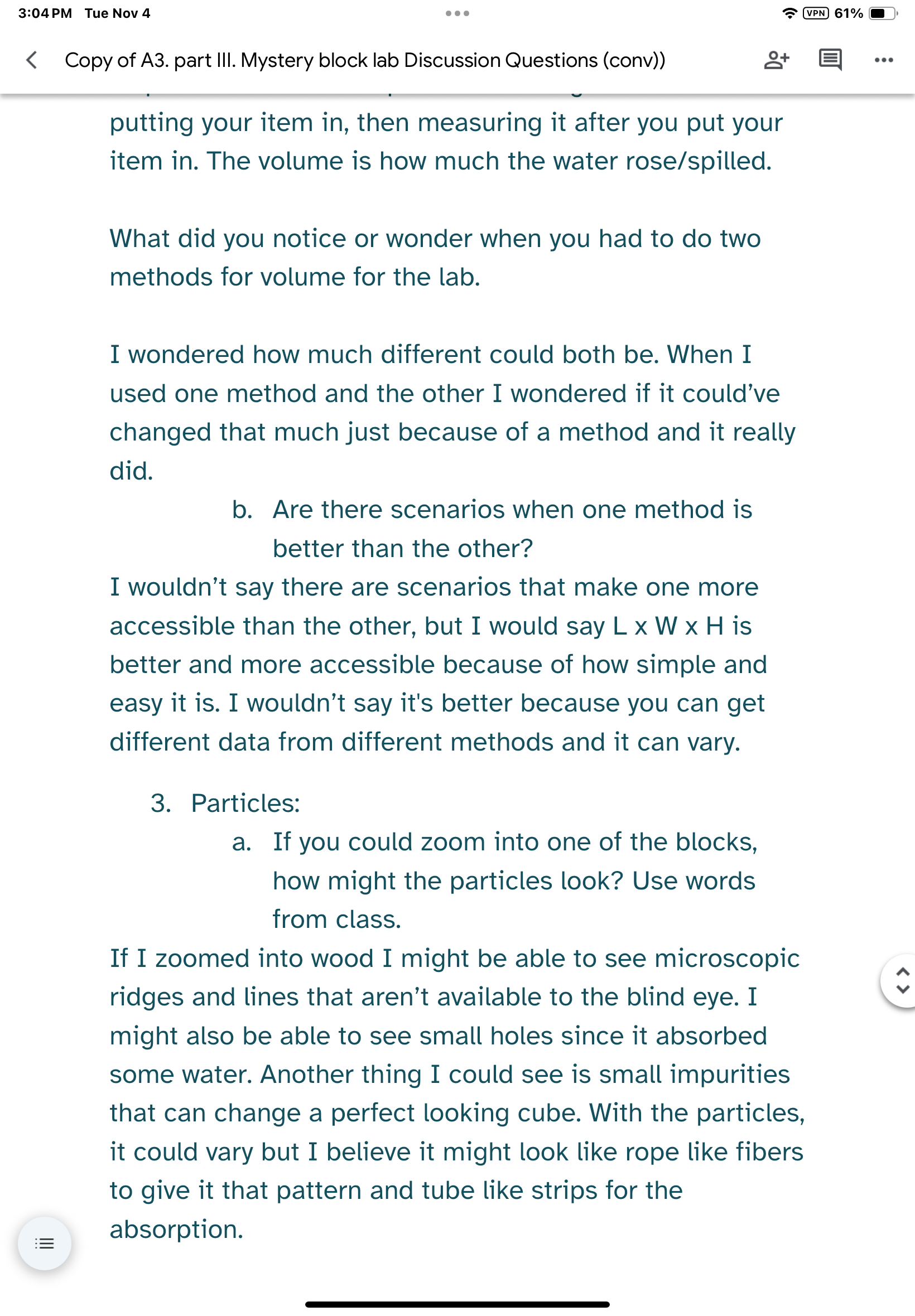
8. What was the author's primary thought when comparing the two volume calculation methods?
Explanation: The author wrote, 'I wondered how much different could both be. When I used one method and the other I wondered if it could've changed that much just because of a method...'
9. Why does the author consider the Length x Width x Height (L x W x H) method to be more 'accessible'?
Explanation: The text states, '...I would say L x W x H is better and more accessible because of how simple and easy it is.'
10. The author does not consider the L x W x H method definitively 'better' for which of the following reasons?
Explanation: The author clarifies their preference by saying, 'I wouldn't say it's better because you can get different data from different methods and it can vary.'
11. According to the student's response, what was their primary observation when comparing two different methods for measuring volume?
Explanation: The student wrote, "I wondered if it could've changed that much just because of a method and it really did," indicating that the two methods produced different results.
12. Why does the student consider the L x W x H method to be "better and more accessible"?
Explanation: The text states, "I would say L x W x H is better and more accessible because of how simple and easy it is."
13. If the student could zoom into a block of wood, what do they hypothesize the particles would look like to facilitate absorption?
Explanation: The student writes, "I believe it might look like rope like fibers to give it that pattern and tube like strips for the absorption."
14. Based on the text, what feature did the student suggest might be visible at a microscopic level because the wood absorbed water?
Explanation: The student states, "I might also be able to see small holes since it absorbed some water."
15. What is the title of the document shown in the image?
Explanation: The title "Copy of A3. part III. Mystery block lab Discussion Questions (conv))" is clearly visible at the top of the screen in the image.