Test your knowledge of the different situations for communication and the various levels of formality in speech, from intrapersonal to intimate styles.
Pages: 4Questions per page: 10
Rate this quiz
☆☆☆☆☆
Avg: 5.00 ( 2 )
Score: 0Page 1 / 4
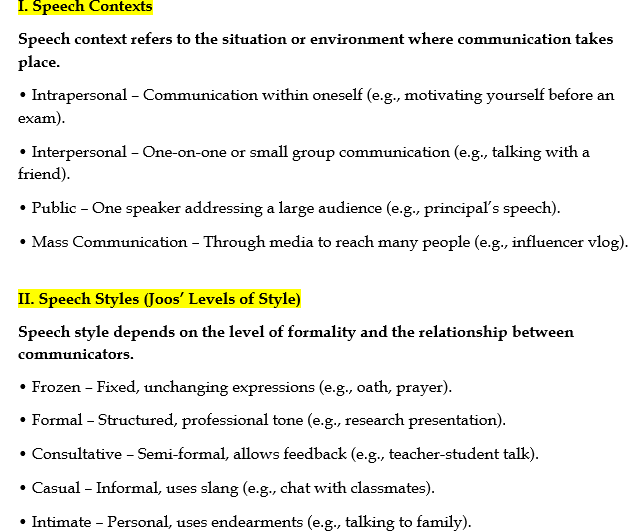
1. According to the image, what is the primary definition of 'speech context'?
Explanation: The text explicitly states, 'Speech context refers to the situation or environment where communication takes place.'
2. A student giving themselves a pep talk before an important exam is an example of which speech context?
Explanation: The text defines Intrapersonal communication as 'Communication within oneself' and gives 'motivating yourself before an exam' as a specific example.
3. Which speech context involves a single speaker addressing a large audience, such as a school principal during an assembly?
Explanation: Public communication is defined as 'One speaker addressing a large audience,' with a 'principal's speech' cited as an example.
4. What two factors determine speech style, according to the text?
Explanation: The image states, 'Speech style depends on the level of formality and the relationship between communicators.'
5. Reciting a wedding vow or a national pledge is an example of which speech style?
Explanation: The Frozen style is described as using 'Fixed, unchanging expressions,' with 'oath' being a key example, which is similar to a vow or pledge.
6. A doctor discussing a diagnosis with a patient, allowing for questions and feedback, would be using which speech style?
Explanation: The Consultative style is defined as 'Semi-formal, allows feedback.' A doctor-patient conversation fits this description, similar to the provided 'teacher-student talk' example.
7. What is a key characteristic of the 'Casual' speech style?
Explanation: The text defines the Casual style as 'Informal, uses slang,' with an example being a 'chat with classmates.'
8. An influencer's vlog shared on social media is classified under which speech context?
Explanation: Mass Communication is defined as communication 'Through media to reach many people,' and the text provides 'influencer vlog' as a direct example.
9. Which speech style is most personal and typically used when talking to family?
Explanation: The Intimate style is described as 'Personal, uses endearments,' with 'talking to family' as the provided example.
10. What is the main difference between Public communication and Mass Communication as described in the text?
Explanation: The text defines Public communication as addressing a 'large audience' (like a speech) and Mass Communication as being 'Through media' (like a vlog), highlighting the role of media as the key differentiator.
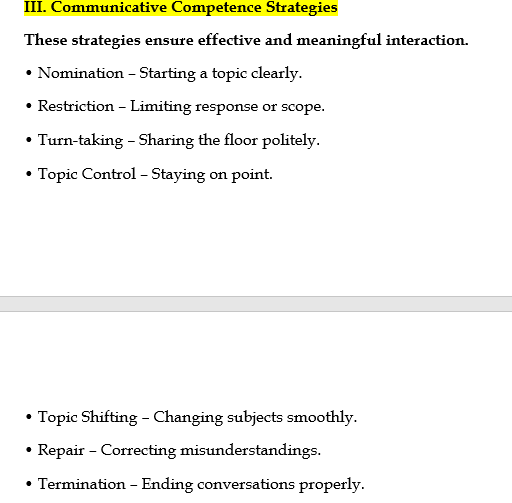
11. According to the image, which communicative strategy is defined as 'Starting a topic clearly'?
Explanation: The first bullet point in the list explicitly defines 'Nomination' as 'Starting a topic clearly'.
12. What is the primary goal of the communicative competence strategies listed in the text?
Explanation: The text states, 'These strategies ensure effective and meaningful interaction.'
13. If a person in a conversation says, 'Wait, I think you misunderstood me. What I meant was...' which strategy are they employing?
Explanation: The 'Repair' strategy is defined as 'Correcting misunderstandings'.
14. The strategy of 'Staying on point' during a conversation is called:
Explanation: The image defines 'Topic Control' as 'Staying on point'.
15. Which of the following best describes the 'Turn-taking' strategy?
Explanation: The definition given for 'Turn-taking' is 'Sharing the floor politely'.
16. A teacher telling her students, 'For this question, please give me a yes or no answer,' is an example of which strategy?
Explanation: The teacher is 'Limiting response or scope,' which is the definition of the 'Restriction' strategy.
17. Which strategy involves 'Changing subjects smoothly'?
Explanation: The text defines 'Topic Shifting' as 'Changing subjects smoothly'.
18. Saying 'Well, it was great talking to you. I have to go now' is an example of which communicative strategy?
Explanation: This is an example of 'Ending conversations properly,' which is the definition of 'Termination'.
19. What is the difference between Topic Control and Topic Shifting?
Explanation: Topic Control is defined as 'Staying on point,' whereas Topic Shifting is 'Changing subjects smoothly'.
20. Which of these strategies is NOT listed in the top section of the image?
Explanation: Nomination, Restriction, and Turn-taking are in the first list. Repair is in the second list, below the gray line.
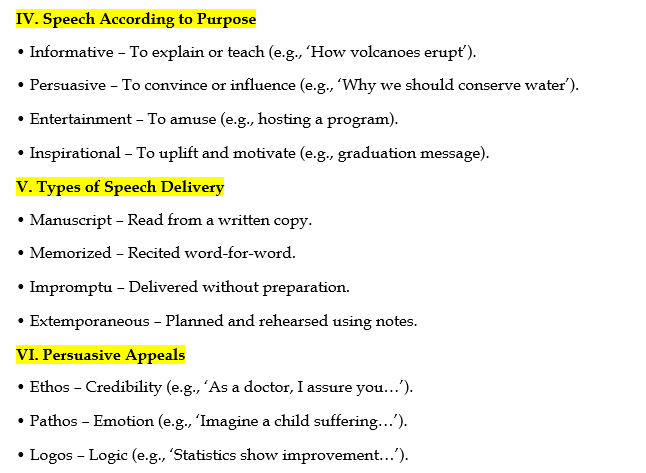
21. According to the image, what is the main purpose of a persuasive speech?
Explanation: The text explicitly defines a persuasive speech's purpose as 'To convince or influence' and provides the example, 'Why we should conserve water'.
22. A student is asked to give a speech on the spot without any time for preparation. Which type of speech delivery would this be?
Explanation: The image defines an impromptu speech as one that is 'Delivered without preparation'.
23. A speaker starts their speech with, 'Statistics show that 90% of plastic waste is not recycled.' Which persuasive appeal is being used?
Explanation: Logos is the appeal to logic, which often involves using facts, data, and statistics, as shown in the example 'Statistics show improvement...'.
24. A valedictorian giving a graduation message to uplift and motivate their fellow students is delivering which type of speech?
Explanation: The text identifies an inspirational speech as one intended 'To uplift and motivate,' citing a 'graduation message' as a specific example.
25. What is the key characteristic of an extemporaneous speech delivery?
Explanation: The image defines an extemporaneous speech as one that is 'Planned and rehearsed using notes,' distinguishing it from manuscript, memorized, and impromptu deliveries.
26. A lawyer stating, 'As a certified legal expert, I can tell you this contract is invalid,' is using which persuasive appeal?
Explanation: Ethos is the appeal to credibility and authority. By highlighting their status as a 'certified legal expert,' the speaker is establishing their credibility, similar to the example 'As a doctor, I assure you...'.
27. Which of the following is an example of an informative speech topic?
Explanation: The purpose of an informative speech is 'To explain or teach.' The image provides 'How volcanoes erupt' as a direct example of an informative speech topic.
28. A speaker using a heart-wrenching story about a suffering animal to encourage donations to a shelter is primarily using which appeal?
Explanation: Pathos is the appeal to emotion. Telling a sad story to evoke an emotional response from the audience fits this description, as suggested by the example 'Imagine a child suffering...'.
29. What is the main difference between a manuscript and a memorized speech delivery?
Explanation: The text defines a manuscript speech as 'Read from a written copy' and a memorized speech as 'Recited word-for-word,' highlighting the core difference in their delivery method.
30. Which of these is NOT listed as a type of speech according to its purpose?
Explanation: Extemporaneous is listed under 'Types of Speech Delivery,' not 'Speech According to Purpose.' The purposes listed are Informative, Persuasive, Entertainment, and Inspirational.
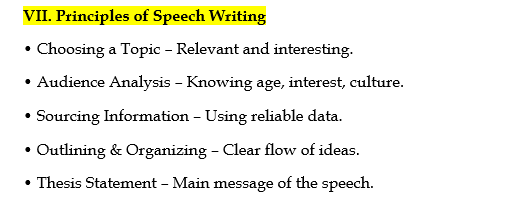
31. What is the main topic presented in the image?
Explanation: The title highlighted in yellow at the top of the list clearly states 'VII. Principles of Speech Writing'.
32. According to the image, what are the two essential characteristics of a good speech topic?
Explanation: The first bullet point, 'Choosing a Topic', is described as selecting something 'Relevant and interesting'.
33. Which of the following elements is mentioned as a part of 'Audience Analysis'?
Explanation: The bullet point for 'Audience Analysis' lists knowing the audience's 'age, interest, culture'.
34. What is the guideline provided for 'Sourcing Information'?
Explanation: The image explicitly states that 'Sourcing Information' involves 'Using reliable data'.
35. What is the primary purpose of 'Outlining & Organizing' a speech?
Explanation: The description for 'Outlining & Organizing' is to create a 'Clear flow of ideas'.
36. How does the image define a 'Thesis Statement'?
Explanation: The last bullet point defines the 'Thesis Statement' as the 'Main message of the speech'.
37. If a speaker is considering the age and interests of their listeners, which principle of speech writing are they applying?
Explanation: The principle of 'Audience Analysis' is described as 'Knowing age, interest, culture' of the listeners.
38. Creating a logical structure for the speech corresponds to which principle?
Explanation: Creating a logical structure ensures a 'Clear flow of ideas,' which is the goal of 'Outlining & Organizing'.
39. Which principle focuses on the central point or core argument the speaker wants to convey?
Explanation: The 'Thesis Statement' is defined as the 'Main message of the speech,' which is its central point.
40. According to the list, what is the importance of the data used in a speech?
Explanation: The principle of 'Sourcing Information' emphasizes 'Using reliable data'.